On Accountants, Planned Maintenance and Reserve Funds etc
A collection of AI generated comments:
Introduction
Qualified accountants are competent to certify the financial balance and transactional history of reserve funds, but they are not competent to determine or certify the physical adequacy or required quantum (the appropriate size) of those reserves.
When dealing with leasehold service charges in the UK, a clear distinction must be made between verifying financial figures and assessing structural property needs:
On Accountants
What Accountants Can Certify
- Financial Accuracy: Independent qualified accountants (such as members of ICAEW or ACCA) can certify that the year-end statement of accounts accurately reflects the actual income received, expenditure made, and interest accrued within the reserve or sinking fund.
- Fund Balances: They can verify that the stated cash balance of the reserve fund matches the bank records and is legally ring-fenced in a designated trust account.
- Accounting Compliance: They ensure the accounts are prepared on an accruals basis in compliance with the Landlord and Tenant Act and industry guidelines like TECH 03/11.
What Accountants Cannot Certify (The "Quantum")
- Adequacy of the Reserve: An accountant cannot determine whether £50,000 or £500,000 is the correct "quantum" a building needs to hold for future works. They have no professional training in assessing structural depreciation or construction costs.
- Future Maintenance Costs: Setting the correct quantum of a reserve fund requires a Planned Maintenance Programme (PMP) or a lifecycle costing assessment. This must be carried out by a Chartered Engineer [C.Eng], Chartered Surveyor (RICS) or a qualified Building Engineer who assesses physical elements like the lifespan of the roof, lifts, and brickwork.
- If a lease requires the landlord to maintain a "necessary" or "reasonable" quantum of reserves, the landlord must rely on a surveyor's valuation to set the budget, while the accountant simply audits and certifies that the money collected is handled correctly according to those parameters.
Reserve Funds
If you believe the reserve fund demands are over-inflated, you have the legal right to challenge them. Under Section 27A of the Landlord and Tenant Act 1985, leaseholders can challenge both past service charges and estimated future costs (which includes reserve or sinking fund demands) on the grounds of "reasonableness".
- Check the Lease Wording First
- Before arguing about the amount, check if the landlord even has the legal right to collect a reserve fund.
- The authority must be explicit: A landlord cannot collect a reserve fund unless the lease explicitly allows it.
- In a notable Upper Tribunal ruling (Challenor-Gardiner), it was reaffirmed that a general "repairing obligation" does not give a landlord an implied right to collect a reserve fund. If the clause isn't in your lease, the entire demand is invalid.
- Request the Supporting Evidence
- If the lease allows a reserve fund, the landlord must still prove the requested amount is reasonable. You should formally request:
- The Planned Maintenance Programme (PMP) or Lifecycle Costing Report: The managing agent should have a professional Engineers or surveyor's report backing up the figures. If they are asking for £100,000 without a such a report, they are essentially guessing, which is highly challengeable at a tribunal.
- Historical expenditure: Look at how much has actually been spent out of the reserve fund historically to see if they are simply hoarding cash without carrying out the works.
- Build Your Case
- If they provide a PMP but you still believe it is over-inflated, your evidence will need to counter theirs. A First-tier Tribunal (FTT) handles these disputes using professional benchmarks. You can build a case by:
- Obtaining alternative quotes: If they claim a roof replacement will cost £80,000 in five years, look into local surveyor or contractor estimates to see if that figure aligns with market rates.
- Checking for double-recovery: Ensure they aren't collecting a massive reserve for items that are already covered by building insurance policies.
- Identifying historical neglect: If an area needs massive repairs now because the landlord neglected basic maintenance for years, you can argue that leaseholders shouldn't pay an inflated reserve to fix the landlord’s historical breach of duty
- If they provide a PMP but you still believe it is over-inflated, your evidence will need to counter theirs. A First-tier Tribunal (FTT) handles these disputes using professional benchmarks. You can build a case by:
- 4. How to Dispute the Charges
- 1. Pay "Under Protest": Do not simply withhold your service charges, as this can put you in breach of your lease and trigger forfeiture or legal costs. Pay the demand but explicitly state in writing that you are "paying under protest and reserving the right to challenge the reasonableness at the First-tier Tribunal".
- 2. Form a Leaseholder Group: Challenging managing agents as a single leaseholder is expensive and draining. Band together with your neighbours to split the costs of hiring an independent Chartered Engineer RICS surveyor or legal representation.
- 3. Apply to the First-tier Tribunal (FTT): If informal disputes and mediation fail, you can file an application to the First-tier Tribunal (Property Chamber) using Form Leasehold 1. The tribunal will independently assess whether the landlord’s demand falls within a "range of reasonable outcomes" or if it is genuinely excessive
More about going to the First Tier Tribunal
On Maintenance Plans
If the Planned Maintenance Programme (PMP) is "fictional"—meaning it is based on fabricated timelines, phantom assets, or arbitrary numbers rather than a genuine physical survey—the landlord’s reserve fund demand lacks a legal foundation.
Under Section 19 of the Landlord and Tenant Act 1985, costs can only be collected to the extent that they are "reasonably incurred". If a landlord demands money based on a fabricated or unevidenced schedule, they are failing the reasonableness test.
The First-tier Tribunal (FTT) explicitly expects a reserve fund forecast to be based on an authentic stock condition survey. If you believe the PMP is a sham, you can systematically dismantle it and challenge the charges using the following strategy:
- 1. Audit and Expose the Fabrications
- Cross-reference the items listed in their "fictional" PMP against the physical reality of your building. Look for clear, undeniable errors to show a tribunal that the document is a desktop fabrication:
- Phantom Assets: Does the PMP claim money for assets the building doesn’t even have? (e.g., budgeting £30,000 to overhaul an electronic gate system when you only have a manual wooden gate).
- Impossible Lifespans: Does it budget to completely replace a roof or boiler that was newly installed just two years ago?
- Double-Counting: Check if they are demanding money for an item in the PMP while simultaneously charging you for the exact same repair in the standard annual service charge budget.
- 2. Formally Request the Underlying Evidence
- A PMP cannot legally be generated out of thin air by a property manager sitting at a desk; it must be compiled by a qualified professional. Use your legal right to request information to demand the following backing evidence:
- The Surveyor’s Identity: Ask for the name, RICS registration number, and company of the surveyor who drafted the report.
- The Date of Inspection: Demand to see the date the physical site survey took place. If they cannot provide a signed, dated report from an independent professional, the PMP holds zero weight at a tribunal.
- The Survey Invoice: Check the service charge accounts to see if a surveyor was actually paid to do a PMP survey. If no such invoice exists, the PMP is almost certainly fabricated.
- A PMP cannot legally be generated out of thin air by a property manager sitting at a desk; it must be compiled by a qualified professional. Use your legal right to request information to demand the following backing evidence:
- 3. Take the Case to the First-tier Tribunal (FTT)
- If the managing agent refuses to back down or cannot produce a legitimate surveyor’s report, your next step is to apply to the First-tier Tribunal (Property Chamber).
- The FTT routinely slashes or completely pauses reserve fund collections when landlords try to hoard cash without a credible major works plan. In your tribunal application, you will argue "under-transparency" and "over-collection". Your witness statement will simply highlight that the landlord has failed to provide a professional, costed maintenance schedule to justify the figures. The burden of proof will then shift to the landlord to justify where they got those numbers.
On GDPR - What data can a Property Manager or Freeholder ask for ?
This is a very interesting question.
Here is one simple response to the indelicate questions asked for which an answer is demanded, and a perfectly reasonable one crafted by AI would be to ask the managing agent:
“Before I provide my tenants' personal contact details, please confirm the purpose for which you require their names, telephone numbers and email addresses, the lawful basis on which you will process that information, and provide the relevant privacy information applicable to the tenants.”
There may well be a legitimate reason. For example, emergency access, safety communications or necessary building-management contact could potentially justify some sharing. But “we would like the details for our records” isn't by itself a lawful basis under the GDPR.
Questions about a lessee registering as a landlord in order to let their flat out is simply way out of order.
Or of course there is the great British solution - ignore the form.
More interesting questions to be asked of a Property Manager are:
- Complaints procedure.
- Data Handling procedure.
1. The Property Institute (TPI) requires all of its member firms and company members to have a written in-house complaints handling procedure.
Key Requirements:
- Written Procedure: Members must maintain a clear, documented complaints procedure.
- Public Availability: The procedure must be publicized and provided to any leaseholder, resident, or client who requests a copy.
- Ombudsman Access: Members must also offer access to an independent, government-approved ombudsman scheme.
- Resolution Window: Formal complaints typically must go through the member's internal process first (for up to eight weeks) before the independent ombudsman will step in to investigate an unresolved dispute.
2. The Property Institute (TPI) expects its company members to handle data in compliance with data protection laws and provides dedicated TPI Guidance Notes on GDPR, though a specific written procedure like a complaints handling procedure falls under broader legal compliance rather than a standalone mandatory TPI-published template of that exact name.
Key Data & Compliance Context
- Legal Obligation: TPI member firms must comply with the UK General Data Protection Regulation (UK GDPR) and the Data Protection Act 2018 as part of operating within the law.
- Member Guidance: TPI provides specialized resources, training courses (such as Data Protection and GDPR in Leasehold Management), and advisory notes to help members establish compliant data processes, detect breaches, and manage subject access requests.
- Accreditation and Audits: Company members undergo periodic compliance reviews and audits evaluating general management and operational standards.
-
Property Manager Survival etc
Introduction
The rate at which Property Managers are being replaced has increased rapidly meaning that they are serving for shorter and shorter periods. The BIG question is why ? Possibly they are refusing to obey unlawful instructions and or refusing to act in, what might be construed, a criminal manner.
The graph below illustrates the survival times of past Property Managers.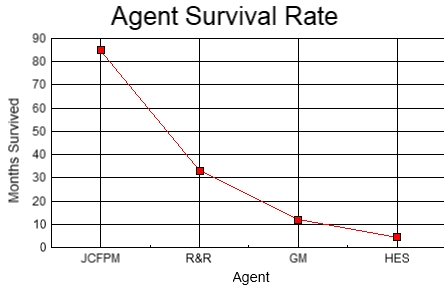
So what errors of judgement, or what management failures have caused all of this ? The following comments may indicate the main problems:
Agent: J C F Property Management [previously J C Francis & Partners]
The main problem was the unlawful erection of cladding in the autumn of 2017 to the fronts of the blocks along the protected fire routes on the first and second floors and around the three main entrances.
The cladding was not the subject of a Section 20 process. Full details are contained in the original report.
This was reported to the London Fire Brigade who issued an order to make safe the protected fire routes on the first and second floors. This has studiously been ignored by Board of Directors, and by the Property Manager.
When the insurance documents were demanded in January 2021, they were fully and promptly provided.
It became evident that the cladding had NOT been declared to the insurance company who at that time was Allianz.
In 2021, Allianz were made aware of this misrepresentation, and promptly withdrew cover retaining the balance of the insurance premium.
The Board blamed the person employed by JCFPM who was managing the property.
This person was reported to the IRPM and duly censured.
The estate was not properly insured therefore from Autumn 2017 until 11th August 2021.
JCFPM were complicit in the erection of the cladding and the insurance failure. The complaint to the RICS was batted off by the MD's lack of recollection of events [aka Prince Andrew Disease].
Further in 2018, an excessive fixed service charge was introduced supported by a report from DHP concerning the roof. Monies collected have been expended on other unnecessary projects.
Agent: Rendall & Rittner
Suddenly on 1st July 2022 without any consultation with lessees [owners] the property manager changed.
The Board raised a complaint against the author of this web site with his professional body. This effectively fizzled out, and did not improve the career prospects of the chairman of their complaints committee, who took no disciplinary action. A similar complaint to another organisation was simply ignored, although the author was sent the somewhat defamatory complaint documents. Lawyers determined that damages would not be worthwhile so the concept of litigation was dropped. It appears that defamatory complaints are common place.
Rendall & Rittner refused to provide full details of the insurance as required under the Lease, and the Landlord & Tenant Act. However, enough information was collected by various different lessees which when collated and analysed demonstrated that for the period 11th August 2024 to 10th August 2025 there was little doubt that the estate was not proper;y insured as required by the Lease.
Their Managing Director made what might be described as a classic comment that he did not agree with the London Fire Brigades Notice of Deficiencies which he described as "simply an opinion". Noted that Chartered Valuation Surveyors, even having attained Fellowship of the RICS are simply not competent to make such a judgement.
Agent: Grace Miller
An April Fools Joke - NOT. On 1st April 2025 again without any consultation with lessees [owners] the property manager was changed.
A group of concerned lessees made a concerted effort to persuade Grace Miller to assist them in replacing the Board of Kersfield Maintenance Ltd.
The Matters of Concern were assembled and posted on this web site.
Some insurance documents were provided which indicated that for the period 11th August 2024 to 10th August 2025 was invalid. This insurance contract was taken out under the previous managing agent, but they may not have been involved.
Grace Miller advised that they were NOT involved with placing of the insurance for the year 11th August 2025 to 10th August 2026.
On 24th November 2025, Grace Miller were requested to provide the insurance documents but declined.
At the same time, complaints and action about the letting out of garages for commercial purposes were taken, and A H Peck vacated the five garages that they had "leased" from a lessee at Garden Royal. Noted that under FOI, Wandsworth Borough Council stated that they had inspected the garages before they were vacated and had found no evidence of commercial use. [This matter remains to be reported to the relevant authority].
Agent: HES Estate Management
Another April Fools Joke ? No - just another property manager from 1st April 2026.
It was decided to approach the principal director and a major shareholder and point out the error of his ways in doing business with the Board of Kersfield Maintenance Ltd. In his wisdom he ignored the proffered advice.
The accounts due in March 2026 but on 7th July 2026 were postponed as allowed under Section 21 of the Landlord & Tenant Act. A schedule of service charge costs was provided. The long running complaint being handled by the ICAEW about allocation of insurance costs to the relevant year was resolved with the cost apportioned in a manner which concurred with the author's calculation.
The insurance documents for the period were demanded, but not provided. However a statement was made that they would be provided "in September". Not by HES in any event.
Agent: Proactive Block Management
On 10th September 2026, a letter from Kersfield Maintenance Ltd. was received by email stating that the window cleaning would take place on 17th September 2026, and take two days.
The implication was that yet again a new property manager had been appointed: this was confirmed by a telephone call to the previous agent HES.
On 12th September a demand for the insurance information was made by email, along with a request that all the lessees' concerns [as outlined on this web site] be addressed within seven days.
This email also pointed out that ARMA was now part of The Property Institute. By 13th September this error on their web site had been corrected.
From 1st September 2026
PLEASE use landscape mode on a mobile phone, or much better use a pc.
If you wish to view the correspondence etc then please email the
About Anti-competitive tendering.
AI Overview
Anti-competitive tendering law - commonly known as bid rigging or collusive tendering - is illegal under the Competition Act 1998 in the UK. It happens when competing businesses manipulate a contract bidding process, destroying genuine competition and resulting in inflated prices or predetermined outcomes for public and private buyers.
Common Types of Illegal Tendering
- Bid rotation: Businesses take turns being the designated winner of a tender while others submit intentionally high or uncompetitive "cover" bids.
- Bid suppression: One or more competitors agree to refrain from bidding or withdraw a submitted bid so a specific company wins.
- Price collusion: Competitors secretly coordinate on the exact pricing, fee structures, or specific commercial conditions they will submit.
- Market allocation: Firms divide up contract opportunities by geographic region, customer type, or specific project sectors.
Legal Enforcement and Penalties
- Regulatory authority: The Competition and Markets Authority (CMA) investigates and penalises collusive tendering behaviour in the UK.
- Corporate fines: Companies found guilty can face severe financial penalties reaching up to 10% of their annual global turnover.
- Personal consequences: Individuals involved can face criminal prosecution, director disqualification orders for up to 15 years, or prison sentences for hard-core cartel fraud.
- Procurement exclusion: Under regulations like the Procurement Act, suppliers found in violation face mandatory exclusion and risk placement on a central debarment list, barring them from public sector contracts for up to five years.
Editors Note:
It is the "resulting inflated prices" which make possible "commission payments" to the parties involved in awarding contracts.