Making a Complaint
Based upon http://accountabilityscotland.org.uk/making-a-complaint written by Townsend-Rose in his capacity as Treasurer [and webmaster]
Explanation of Terms
When making a complaint, it is essential to understand what is meant by the language used by the organisation to whom you are complaining, and well as the firm about whom you are complaining, or of the employer of the person about whom you are complaining.
Remember that the procedures that these organisations operate are set up to not only confuse but also to deflect potential complainants.
Some of the common terms are:
- Time limit. They say that you must complain within so many weeks of an event. Mostly this can be interpreted as "so many weeks after you discover the event". The event must be reasonably discoverable of course.
- Authority. They will say that you are not entitled to complain.
- Wasting time.
- Maladministration includes:
- unreasonable delay
- rudeness
- failure to apply the law or rules properly.
- Acting in a Vexatious Manner [see below]
There may be other failings that are also ‘maladministration’ – the most quoted definition is that of a Cabinet Minister, Richard Crossman, who in 1967 who listed 'bias, neglect, inattention, delay, incompetence, ineptitude, perversity, turpitude and so on'. However, as a judge - Lord Denning - noted in 1979 'and so on would be a long and interesting list, clearly open-ended, covering the manner in which a decision is reached or discretion is exercised ...'.
How to obtain information, and filing
The main source of information is the management firm with whom you are dealing:
- Firstly, keep a record of every communication. You should make a "contemporaneous note" or record of telephone calls made and received.
- Secondly, print all "emails" to pdf.
- Lastly, of course keep every piece of paper that comes your way. It is strongly recommended that you scan these and save as a "searchable pdf".
There are a number sources of information:
You have a right to certain information under the various laws etc. Both the following are managed under the UK Information Commissioner's rules.
- Subject Access Request
https://ico.org.uk/your-data-matters/your-right-to-get-copies-of-your-data/preparing-and-submitting-your-subject-access-request/ - Freedom of Information Request from from a public authority
https://ico.org.uk/for-the-public/official-information/
Laws etc include:
- The Landlord & Tenant Act.
- Your lease, or the deeds, to your property.
- There may well be other information that you should be sent
The only problem is when you ask for say insurance information, and the management firm simply refuse to supply it, possibly because they have received an unlawful instruction from the free holder.
Next is filing. First there is the big question:
- Are you going to "go electronic" and turn all paper into searchable pdfs - but keep all the paper anyway, or
- Are you going to stay "mixed" - with some stuff electronic and some stuff paper ? NOT recommended.
Assuming you are going to go the electronic route with any paper filed as well. It is suggested that you name "electronic files" as follows:
yyyymmdd_xx_source_recipient_subject, where:
yyyymmddd represents the date of the document [as opposed to the date you received it]
xx is an optional sequential number to get emails of the same day in the correct order.
source and recipient are mnemonics for the people or firms you correspond with. Use capitals like RR for Rendall & Rittner
subject can be the subject or the specific person who you are dealing with, or both.
Note: use underscores NOT spaces.
Don't forget that computers use text - so "01" comes before "1", and "2" comes after "10". Thankyou to Microsoft et al.
"from" should be an acronym - like XXCC - meanning Xxxx Xxxx City Council.
"from" might have an extension like XXCC-initials [of the particular person]. Legally ALL documents from an entity such as XXCC are all deemed to be from the same authority.
"to" should be identical to "from" - so that you can see a conversation.
"subject" should again be an acronym.
It is good practice to make a list of the acronyms you have used.
How to take action - Make a Plan
Introduction
The military have a slogan - SMEAC. It covers the scope of orders received and issued at platoon level - not how the orders are generated, which requires careful planning. SMEAC is translated as follows:
Situation
Mission
Execution
Action
Communications.
The situation is the one you find yourself in. And it is one which you grossly dislike. You may be considering making a complaint, but your instinct tells you do it will probably fail - after all most complaints management systems are NOT about improving things but about protecting the guilty; and secondly that if you go to court the system has an experienced legal team and very very long pockets.
So the mission is simple - get things sorted yourself. This requires setting an objective, or series of objectives - all of which must of course be achievable within whatever constraints one has - time, effort, ability, and money - whether yours or someone else's. The mission requires a plan - and that is what this article is all about.
Execution is an important part: there is no point in having a plan which cannot be executed. And of course there will be lots of information to be provided like where when and how. So the gathering of information before execution is both a painstaking and vital process.
Action. This is where what is going to be done is defined in detail, by whom, and in what order. The details of the plan in other words.
Communications. Who is to say what to whom and when.
About creating a Plan
The first thing to write down is your Objective, which will basically be what you want to achieve and why:
is it for you ?
is it for rectification of a wrong ?
just to obtain an apology ?
or for good old fashioned revenge - an eye for an eye ?
or for the greater good to make sure it never happens to anyone else ?
Before you can create a plan you need to gather all the relevant information.
A note on what is relevant:
The structure of the organisation you are having a problem with - who is who, who reports to who, etc etc.
The relevant rules, statutes, etc, and what may be in the Organisation's rule book. An example is Scottish Water's rule book which is published by a private limited company called CMA [Central Market Agency] - so it does NOT have the authority of Law, but be warned lawyers for the opposition and others will quote it as if it were.
The breaches of the Law, or Rules, and who breached them. It is probable that there will be several.
About Gathering Information
First one has to gather the facts for analysis. Remember, whether its been written down or just said, the ABC rule [supposedly to be the mantra of every policeman]:
Accept Nothing
Believe No one
Challenge Everything
And then there is the standard of proof - or reliability of the information. There are three levels - well two plus the last one: reality.
Civil - on the balance of probability,
Criminal - without any reasonable doubt,
However, for civil servants, the truth absolute and final with no dubiety.
There are a number of ways to gather public information
Freedom of Information request [viz an FOI] - but you cannot go "fishing".
Subject Access Request [viz an SAR] - about yourself.
If you do NOT like the result of the FOI, or SAR, you can always raise an objection.
However, the gathering of information is a hugely time consuming and difficult task.
Indexing of Information
All records should be indexed, and record of conversations made as soon as is possible after it took place, if it was not recorded: and is recorded it should be transcribed as soon as practicable.
Presenting the History
Having sorted out all your information into indexed documents,the firts task is to write a "timeline". This just a list of dates and key events, and where necessary the important documents.
The next task is to write "short stories" about each breach about which you are complaining. This can be a very painful experience. It is often best to write them in the third person, using the acronyms defined above, in the text.
Do not at this stage make allegations, write the facts and only the facts as supported by your information - which should be referenced to the documents: do NOT quote vast sections of the documents, it becomes wholly unreadable to anyone else.
Each story should be written in short sentences, and kept into short paragraphs. It may be worth explaining briefly why something occurred, and what was happening - NOT what you would have liked to happen, NOR anything judgemental.
Presenting the Case
This would be referred to as the indictment in a court of law.
Set out firstly a summary of the events as you see them, and for each one state what laws or rules were broken. Each event should have one or more a stories about them. So in reverse, each story becomes an event. Try not to intermingle them.
You may need then to identify a person and describe their traits - falsification of facts - remember that they will be doing the same to you ! So make sure that you are correct - see the last item under Standard of Proof above.
Having done that, get a third party to review what you have done.
The Plan
Now you are possessed of all of the facts, you can work out what to do with them.
Dwight D. Eisenhower famously said "In preparing for battle I have always found that plans are useless, but planning is indispensable".
It is the effort of planning [and the gathering of information] which is in valuable.
Consider the risks and expense of going to Court, to an Ombudsman [free], or the IC [also free], but also what if they do NOT see things your way. Recent reports suggest that "the system" is loaded against complainants.
Get an outsider to review your efforts, and keep it all in manageable chunks. Such a chunk will fit on one side of A4 paper.
Presenting your case
An important general rule is to think about how the recipient may react to what you write (or rather, how you would react). That person may or may not be well-meaning, diligent and intelligent, but is probably overworked, with much else to read and think about. How might you react to abuse? Do not think of all MP's, officials etc as the enemy.
So be brief and concise. Aim for no more than one A4 page, but if there is much supplementary evidence it might go in an Appendix.
Avoid repetition, unhelpful ranting and generalizing beyond what you can actually prove.
If possible, present evidence as exact quotations or at least state that you have it (e.g. from emails, websites, Acts of Parliament, minutes of meetings etc). Avoid merely saying “He/you told me that ....”. Too often such unsupported statements turn out to be untrue - with the whole case collapsing as a consequence.
How to Complain
Years ago in Baltimore, a ward leader calls City Hall to say he has someone who needs a job.
"What can he do?" the mayor asks.
"Nothing," says the leader.
"Good," says the mayor. "We won't have to train him."
From the Baltimore Sun, February 13, 2005 by C. Fraser Smith
Now you may know the type of person who may be handling your complaint
How to Complain
Most visitors to this website have had to complain to public bodies of one kind or another. If the experiences were frustrating, they may also have complained, or are contemplating complaining, to someone else, perhaps their local councilor or Member of Parliament.
Here we try to offer some general advice.
Because the experience can be truly horrendous, associated perhaps with loss of home, health or career, it is important to acknowledge first that it can also be positive, with problems promptly sorted by caring officials. So do not be put off.
The first rule is to make sure that you are complaining to the right person, with the power to act.
Regulatory Bodies receive many complaints that they have no power to handle. Thus they must be about service failure and ‘maladministration’ and they must first have been considered by the Public Service body in question. So be sure to check with the Ombudsman or their website at the start, to save both your time and theirs. In other contexts your constituency MP's may be able to help, but the Parliament generally has no power to consider individual cases.
The second rule is to keep a dated record of everything written and said. Keep all letters and emails, including copies of your own.
The third rule is to give some thought to psychology. A very effective way to get nowhere is to be abusive, because the natural response to attack is to become uncooperative and to ‘put up the shutters’. This does not just apply to the person whom you think has wronged you, but also to any third parties whose assistance you might wish to enlist. People are more likely to help, or be persuaded by, someone who gives the impression of being polite and pleasant. If you are not yourself persuaded by this advice, you could read up on the results of scientific research by social psychologists or, more simply, try a little introspection: think about how you might react to unpleasantness, whether you are guilty or innocent.
Alternatively, you might try imagining yourself to be a council official, for example, and a nice person (as indeed you are, of course) who is accused of making some administrative mistake. You wish to put things right, but you have 103 emails to deal with. The complainant rants abusively at length, then again and again. Soon you cannot bear even to think about the complainant any more. You would rather sort out that problem for that nice Mrs Bucket. The complainant might feel better for having let off steam, but will his or her problem be solved?
Of course, there are incompetent and corrupt officials too, but abusing them does not help either.
Are we suggesting that angry complainants should be two-faced? ‘Restrained and objective’ is a better description. Act in a way that may achieve your goal – and vent your anger on some inanimate object.
In regard to officials and their actions there is not always a clear distinction between ‘good’ and ‘bad’. Often the problem is one of ‘unconscious incompetence’, a blind spot for one’s faults like that of an enthusiastic but tone-deaf singer. This could understandably apply to organizations like the Regulatory Body for which the output is no adequate external monitoring.
So far this has been about specific complaints that concern one personally, but members of This article has more general aims – ‘changing the system’ to put it loosely. Here similar considerations apply. It is counterproductive to lambast the very MPs or civil servants whose help you ultimately need. It is pointless to harry MPs or parliamentary bodies hoping that they will take some action that is actually outwith their power. Nor can they be expected to become fired up by every worthy issue; not every issue has its ‘Millie Dowler moment’. We must play by Parliament’s rules when only Parliament can deliver our goals. We must appear to be well-informed and constructive.
As a final hint, it sometimes helps to ask a question in a letter or email as this demands a response.
There was a website [www.howtocomplain.com] that gave general advice on complaining, e.g. to councils and businesses, and also gives specific guidance – to particular British local councils, for example. There was also guidance on your rights.
Here is a link to their archived web site:
https://web.archive.org/web/20120922105333/http://howtocomplain.com/regulatorybodies
Vexatious Persistent or Tenacious
Are you a "Vexatious" or "Persistent" Complainant - or just Tenacious ?
Many complainants have been described dismissively as constituting vexatious or persistent complainants in relation to their communications with regulatory and parliamentary bodies. This is a way of debasing the complainant and of implying that their arguments are of no consequence. Most serious complainants are indeed tenacious in pursuing their goals and some officials dealt with may be vexed by this, but “vexatious” and “unusually persistent”, and some related terms have a special meaning in psychiatric literature. They refer to a particular category of complainant, possibly fewer than one in twenty, with a tendency to share certain uncommon personality characteristics that can make these people very difficult to deal with.
It is difficult to define to whom this label applies. It is therefore important that the use of such phraseology as a weapon against complainants is combatted. It is also important that one remains “tenacious”, for justified tenacity can be rewarded (i.e. Hillsborough).
The label of “vexatious” is also sometimes used against individual complainants by public officials. It provides an easy way of shutting down an investigation that is in danger of becoming embarrassing.
Several phrases have been used in this general context, including ‘querulant’ or ‘querulous complainant’ as well as ‘vexatious complainant’ and ‘unusually persistent complainant’ (the word ’unusually’ being important here). What are the characteristics of such people? They make an interesting list, but they are also worth noting by any would-be complainant who wishes to avoid being judged as vexatious. You are far more likely to be treated sympathetically and to win your case if you are not tarred by the “vexatious brush”. As you look at the list, you may well think that particular items are perfectly innocuous, justified in some contexts or even potentially helpful. It is therefore important to bear in mind that it is a combination of a number of them together that characterises the vexatious complainant. Here are some of them, taken from a research article (see the first link reference below under "Further Reading" below, by Lester, Wilson, Griffin and Mullen):
Abusive language
Writing letters more than 100 pages long, which are often hard to follow
Numerous telephone calls or letters
Making telephone calls lasting more than an hour
Sending copies of other irrelevant letters
Sending personal character endorsements
Over-use of capital letters and highlighters
Repeated underlining
Numerous inverted commas
Many comments written in margins
Making threats over the phone or in writing
Threatening suicide
Unnecessary repetition
Expressing complaints in an incoherent manner
Involving other agencies
Desire for public recognition of the complainant’s struggles
Demand for retribution or revenge
Use of rhetorical questions
It must be emphasized again that showing just a few of these characteristics should not necessarily brand one as a vexatious or unusually persistent complainant. Most were exhibited by some of the nonvexatious ‘control’ individuals in the study of Lester et al, but to a much lesser degree. There is no excuse for dismissing a complainant or group collectively as vexatious or persistent complainants. Regardless of how one is judged in this regard, what should ultimately matter is whether the arguments are sound and our information correct.
Much of this article is in essence repeated from http://accountabilityscotland.org.uk/making-a-complaint where there is also find an article on anxiety about complaining.
Further reading:
Lester G, Wilson B, Griffin L and Mullen PE (2004) Unusually persistent complainants. BritishJournal of Psychiatry 184, 352-6.
http://bjp.rcpsych.org/content/184/4/352.short
Australian Ombudsman - Unreasonable Complainant Conduct Report – June 2009 - no longer available, but their good practice guide on Managing complex complainant behaviour is available [October 2022]
https://www.ombudsman.vic.gov.au/learn-from-us/practice-guides/managing-complex-complainant-behaviour/
An example in Scotland: Unacceptable Actions Policy - now called Complaints handling practice guide:
https://www.spso.org.uk/complaints-handling-practice-guide
Skilling G, Øfstegaard M, Brodie S, Thomson L. Unusually Persistent Complainants against thePolice in Scotland. This is now to be found at: https://www.sipr.ac.uk/wp-content/uploads/2021/10/Unusually-Persistent-Complainants-against-the-Police-in-Scotland.pdf.you
Writing a Case Study
Why Case studies
Case studies are needed in order to define what is generically going wrong.
The last part of a case study is the "Preventive Action". That is what society needs to make an organisation do in order to prevent another similar occurrence.
How might that happen ? One way is to make proposals for changes in the Law, or Rules of Conduct, or Byelaws, or what ever needs to be amended.
Writing a Case Study
A Case Study is NOT a complaint.
It is a means to an end as is indicated above.
A Case study should contain FIVE elements.
- A description of what happened - a brief history of events only.
- Next is a description of reactions - what exactly did the offending party do or not do.
- Then a description of your expectation - what should the offending party have done or not done.
- This is a necessary part: what should be done to CORRECT the situation: this might be nothing - a wrong leg amputated cannot be replaced. If permission to erect a building was given, but the building has NOT yet been erected, the correction should be to retract the permission granted.
- Lastly and most importantly, what can be done to prevent such a re-occurrence. In the case of the leg wrongly amputated it might be to insist that the hospital's checking procedures are improved, or if they exist to make sure that they are properly implemented; whereas in the case of a planning permission reversal it might be a matter of insisting on better staff training. The possibilities are endless.
About Preventive Action Plans
Whatever you want to recommend must be
- Sensible, and
- Feasible.
Wanting the impossible is impossible.
Demanding that which is possible, but is also fair and reasonable is most likely to gain acceptance from the authorities.
In order to achieve this interaction with the appropriate authority is a must. The existing rules and regulations need to be determined.
It may be that during the course of the events leading to the complaint [upon which the case study is based], the rules and regulations were changed - possibly as a means of escape by the authorities. Examples of this are:
- Sacking [or retiring early] an employee, so that they cannot face disciplinary charges.
This is a nonsense as the authority remains culpable whether or not the specific offender is still employed. - Changing the rules as time proceeds so as to exclude a complaint.
This is also a nonsense. The rules in force at the time of the events is what is important.
However, if the changes that have been made are beneficial in prevent a future occurrence, then no preventive measures are necessary - they have already been implemented. Whereas if the changes that have been made are evasive in nature, then that is wholly unacceptable.
The report
The full report contains ten chapters, which are listed below. Click a chapter heading to read it.
Summary
This report examines the regulatory landscape of property management in England with particular focus on events that have unfolded at Garden Royal, a residential estate in Putney, Wandsworth.
In summary, this report concludes that effective regulation is lacking and highlights deficiencies in the manner in which residential estates are managed and maintained by appointed property managers.
The aforementioned issues at Garden Royal first arose in June 2020 when a lessee replaced a boiler and received a demand for around £2,000 for damage that was said to have been caused to external cladding. The payment demand was to cover repairs which included replacement of the allegedly damaged cladding.
The lessee in question has owned the flat since late 1986 and in the intervening 38 years has kept meticulous records of the estate management, enabling a thorough investigation.
One cause of tension on the estate is the Board of Directors; firstly by disregarding the estate’s parking rules having previously disrupted the external redecoration contract arranged by a previous managing agent using that as an excuse to replace the agent with one more amenable to her.
That the other lessees simply allowed this to happen is not a reason for the estate to become unregulated when ample rules and laws exist to prevent what has happened.
Once complaints began to be made, it was clear that the regulatory mechanisms at Garden Royal simply did not - and do not - operate in a manner that might be expected in a democratic society.
As this report demonstrates, the lack of property regulation at Garden Royal is not an isolated example.
However, what makes this case study unique is that it is based on meticulous records that were kept not out of an expectation that an exhaustive review might in the future be necessary but simply as a matter of course.
The conclusions that arise from this report are as follows:
- Lord Best’s report of July 2019 recommending an independent regulator on the lines of the Financial Conduct Authority is precisely what is needed.
- Lord Bichard’s recommendations of June 2022 for the overhaul of the Royal Institute of Chartered Surveyors (RICS) have failed. Sixteen months later, the biggest problem [that of regulation] remains unaddressed, most likely due to a lack of cooperation of a group of Fellows of the RICS who also run some of the UK's biggest property management firms.
Introduction
The need for a report on the lack of regulation is amply demonstrated by the number of groups campaigning to get their homes into a state of which they can be proud.
These groups are generally to be found on social media sites or have their own web sites. The property management industry responds by using web sites such as Trust Pilot to publish “invited” comments. Ratings for such companies are typically in excess of 50% with 5 stars [good], with the
rest being 1-star [poor]. This is not a “normal distribution” of information.
On Trust Pilot, if the “verified” [meaning invited] 5 star ratings are ignored, then an awful picture emerges of the standard of property management companies.
So what is the problem?
The answer might be said to be that the legal framework is inadequate but that observation would be incorrect but there are, in fact, a preponderance of regulations and rules covering everything from provision of information to fire safety.
It is surprising - to say the least - that one Fellow of the RICS, Richard Davers, managing director of Rendall & Rittner, felt competent to challenge a deficiency notice served by the London Fire Brigade on a residential estate managed by Rendall & Rittner.
The response of the London Fire Brigade was that parties:
" . . . can disagree with the notice of deficiencies that we served, if they wish. As long as their fire risk assessor can prove us wrong."
And this illustrates the problems that are NOT being addressed - that the plethora of rules and regulations, simply put are NOT being enforced by the RICS who have in effect taken upon themselves the role of regulator.
Quote from Lord Bichard’s recommendations:
“ . . . by leading, supporting and regulating a body of skilled professional surveyors and firms who demonstrate the highest ethical and technical standards”
Found at page 64 of Appendix 2 Summary of Recommendations. Regrettably this is simply not the case and most unlikely to be.
This report offers a comprehensive, evidence-based analysis of just one estate, reviewing in detail the property management history at Garden Royal over the last decade. As will be demonstrated, the issues that have arisen at this estate are symptomatic of wider issues faced in many other residential estates.
In particular, the regulatory [viz. complaint handling] mechanisms of several organisations have been tested, and have been found to be wanting - one might even say they are protectionist.
This report is only a commentary and makes no recommendations, but will, it is hoped illustrate the failings within “the system.”
What is abundantly clear is that the property management industry is not effectively regulated to the detriment of the owners and tenants of the UK’s largest asset - property much of which is housing.
About Monetizing the Managed Asset
What is it ?
This is a style of management that might best be described as “squeezing blood out of a stone”.
There is no particular methodology that MUST be adopted, just a willingness to be what one might call “inventive” in the manner in which service charges are raised.
The motive for this style of management is simply stated as exactly that:
Monetizing the managed asset.
What does this mean in practice?
- To levy fees not only for the provision of management services, but also to charge for these services as a provider.
- In a wider perspective, it can result in the following sorts of things:
- Conducting an inspection,
- Writing a report for example on fire safety,
- Conducting [often unnecessary] remedial works, by a related company.
- Another example, not property related, is the inspection of a stable cliff along a river path, then report that works are required, and lastly ensure that these works are carried out by a related company. [See Linnpark.org.uk].
What leaseholders see as ethical, and what supposedly regulated firms see as ethical are in reality rather different.
Some of the practices
One common example is Insurance, where charging can include:
- A commission by the Managing Agent for arranging insurance
- A commission paid to the Directors of the Property Owner
- Commission paid to the insurance brokers.
- The Insurance fee paid to the insurer.
The Financial Conduct Authority has recently outlawed the totality of this. Please see this web site:
https://propertyindustryeye.com/major-concern-for-agents-as-new-legislation-opens-floodgates-for-historic-claims
Electricity is similar to insurance. I many cases the invoice is raised on behalf of the Property Manager by the supplier, and commission is rebated viz the invoice is settled for less that 100%.
The initiator of this scam was Peverel circa 1995.
Another example is allowing the placing of minor works and service contracts with the person responsible for procurement or a firm or business in which the responsible person has an interest.
In the case of Garden Royal this includes the cleaning contract.
The Environment Required to Enable Monetization
The requirements are as follows:
- Firstly is a client who will benefit in some way.
- Secondly a firm of managing agents who is prepared to flout the laws, rules, and regulations.
- Thirdly a regulatory regime which does not operate as it ought to do.
One of the most important “flouts” is contrived between the client and managing agent by the client issuing the project manager with an unlawful instruction. Some examples of such instructions at Garden Royal are:
- Instructing that insurance details that are required to be provided under the Landlord and Tenant Act are not provided. In Garden Royal’s lease it is a further requirement that payment of the premium be evidenced.
- Instructing that a lessee is not permitted to authorize a third party as a representative to make enquiries, and raise complaints on the lessees behalf.
Noted that the client [viz the Directors of the Free Holding company] must have not only the “ability” to get the selected management agent appointed, but also and more importantly to ensure that they stay appointed.
How the client, in this case the Board of Directors of Kersfield Maintenance, does this is of some importance - and relies on their political skills to manage the votes of their fellow lessees. In this respect the history is important, and part of that history is the bullying of people who stand up to them.
Also important in the early history, is how the Directors managed to disrupt the previous managing agent who they wished to replace having chosen a replacement amenable to their ways.
Noted that the above might be defined as “morally corrupt”. However it is common place.
In order to demonstrate this in real life, this case study has been written.
Sadly therefore this report is necessarily both lengthy and complex.
The Regulatory Failures enabling Monetization
There are a number of basic areas where “control” [and by that it is meant the depth and extent of the tentacles of property management irregularities] required:
One of the regulatory organisations the RICS needs to and does exercise control over is the IRPM. Noted that Samantha Michelle Massey FRICS FIRPM is the sole IRPM director [as at 27th February 2024]. And further that she is one of twelve directors of The Property Institute [as at 27th February 2024].
The next area of control is over the complaints mechanism to ensure that Members of the IRPM are protected. Noted that for a short period Amanda Gourlay managed their complaints process, but since the formation of The Property Institute this has passed to the Center for Effective Dispute Resolution. This charity [which it is certainly not] simply provides what are best described as protective findings.
From this it can be concluded that the RICS has obtained effective control of the Property Management industry in the United Kingdom.
It is to be noted that the two largest firms of Property Management are Messrs Rendall & Rittner, and Firstport. Both are now foreign owned.
The saying from Frederic Bastiat is shown in this picture. Circa 1850. It sums up the problem perfectly.
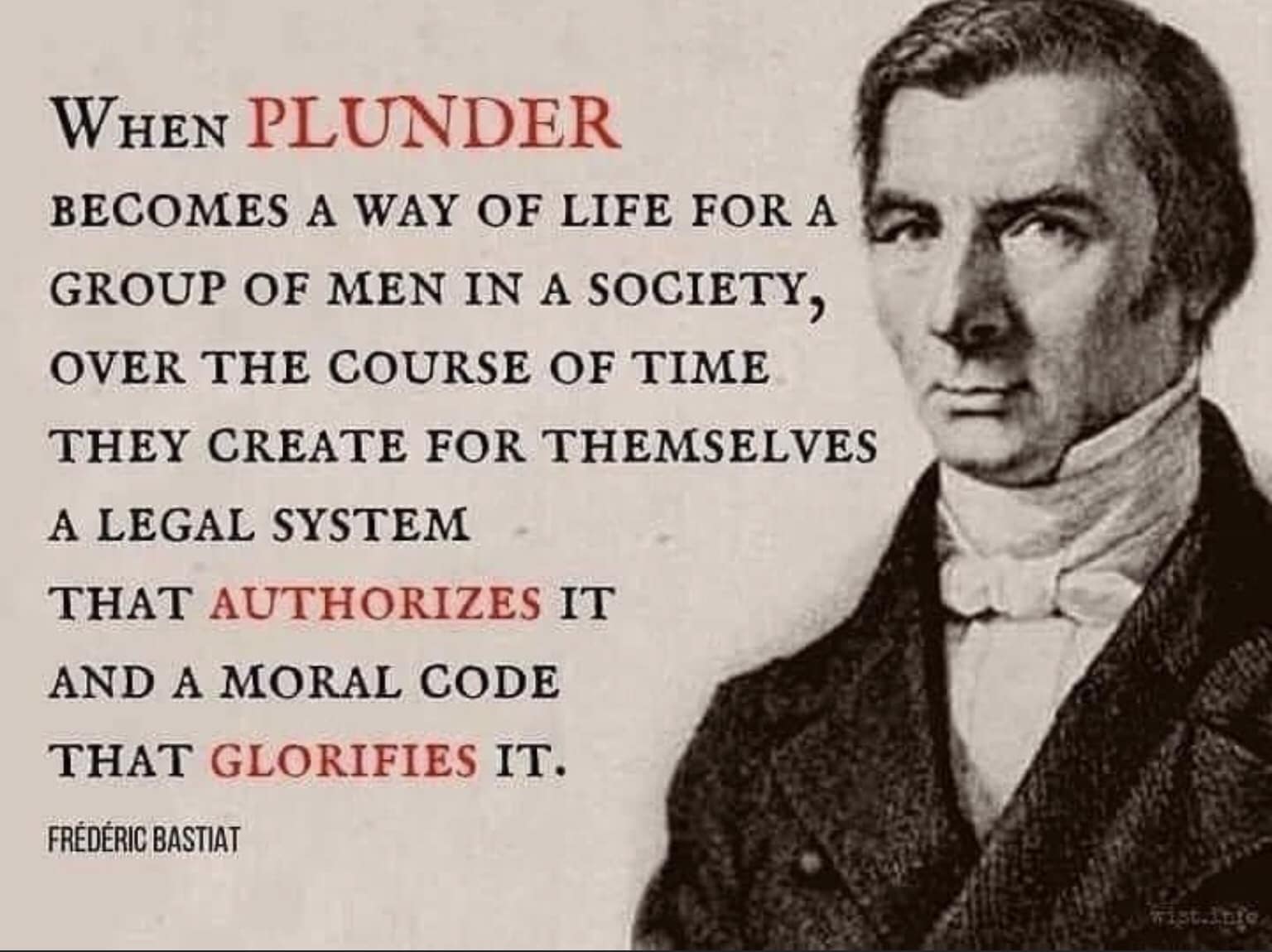 Please see here:
https://www.goodreads.com/quotes/6862167-when-plunder-becomes-a-way-of-life-for-a-group
The tags are given as follows:
anarchy, ancap, coercion, collectivism, countries, freedom, government, libertarian, liberty, mafia, nations, socialism, statism, taxation, taxes, theft, thugs, voluntaryism
Definition of "ancap”: “Anarchy-capitalism is an anti-statist, libertarian political philosophy and economic theory that seeks to abolish centralized states in favor of stateless ...”
Unlawful Instructions and Complaints
What are unlawful instructions?
Paragraph ‘t’ of the Executive Summary of Lord Best’s report contains this sentence:
There are numerous potential sources of complaints against property agents (e.g. other agents, whistle blowers, accountants) that have few if any places to go to raise concerns.
A sentence in paragraph 11 of Lord Best’s report reads:
It can be difficult for an inexperienced owner to know whether their agent is acting lawfully and in their best interests
The final sentence at paragraph 39 of Lord Best’s report states as follows:
A culture of individual responsibility may help promote ethical behavior within an industry, as there will be professional risks when agents refuse to speak out against inappropriate instructions from their clients.
To summarize what an unlawful instruction actually is needs some method of assessment. The following tests are suggested:
- To disobey a law, rule, or regulation.
- To cause loss and or damage under a contract e.g. a lease.
- To infringe the undertakings under a lease.
Performing this Google Search "is it lawful to obey an unlawful instruction property management”, yielded only one good answer:
https://www.reca.ca/2018/04/25/obeying-your-clients-lawful-instructions/
From this article it may be concluded as follows:
A client can never ask you to break the law, mislead, lie, or misrepresent. Industry professionals are required to adhere to the Real Estate Act and Rules. If you are unsure of a request from a client, check the Rules and the Act – or talk to your broker – before moving forward. If the client insists you do something unlawful, you must refuse, and should consider terminating the relationship and any existing service agreement. And,
depending on the seriousness of their request, you may want to inform local authorities.
Examples of unlawful client instructions:
- Your client instructs you to not disclose a material latent defect, such as a leaky foundation. You have a responsibility as a licensed professional to disclose all material latent defects. Not doing so breaches the Real Estate Act Rules
- Your client instructs you to use non-RMS size of a property in your listing. You must use the RMS size if you are representing the size in your listing advertisement, to do otherwise is misleading and a breach of the Real Estate Act Rules.
- Your client instructs you to tell potential buyers there are multiple offers, when there are not. You have a responsibility to be honest. You cannot lie or misrepresent.
- Your client instructs you to include physical aspects of a home in your listing that have not been built yet. As with the examples above, you cannot mislead or lie.
Remember, you work for the client. You are free to advise your client against certain actions, and you can provide your reasons for doing so, but if they wish to continue and instruct you to take a certain action, you must obey. It is your responsibility as an industry professional to understand the difference between lawful and unlawful instructions.
If an instruction is unlawful, explain the reasons it is unlawful, and indicate you cannot obey that instruction.
The Solicitors Regulation Authority has published some usable guidance:
https://www.sra.org.uk/solicitors/guidance/general-dishonesty/
Note: In the original report, this article is repeated.
About Complaints
For every unlawful act or instruction, a complaint can be raised.
Complaints can be raised against one of two entities:
- The property management company itself,
- One or more of its employees - one at a time.
For RICS regulated firms, the following procedure must be followed by a complainant:
- Raise a complaint and submit to the firm under their own complaints procedure. This takes at least two months and up to three or four months if the firm [or its staff] engaged in correspondence.
- When that fails the next step is that the complaint must then be submitted to The Property Ombudsmen Service Limited, or alternative. At this stage “time limits” are applied.
For RICS regulated people Associates, Members, and Fellows it is simpler and consists of:
• Raising a complaint against the person.
Examples of unlawful instructions
A few categories of unlawful actions are:
- Refusing to communicate with lessees and or their lawfully appointed representatives of which there seem to be two categories:
- Refusing to acknowledge a delegation of authority.
- Refusing to acknowledge ownership of a firm which is a lessee.
- Failing to adhere to the rules of the Landlord & Tenant Act.
- Failing to provide insurance information.
- Instructing works for which a Section 20 Notice has been rejected.
- Instructing works for which no Section 20 approval has been sought from lessees and given.
- Failing to adhere to the Fire Regulations and / or London Fire Brigade notices or instructions e.g. in respect of “protected” fire escape routes.
- Refusing to call an Extraordinary General Meeting.
Some Effects of Unlawful Instructions
The most common effect is simply to increase service charges. However there are other more serious effects as illustrated below.
At Garden Royal, the erecting of cladding has had the following effects:
- The sale value of properties is diminished [e.g. £750k to £615k],
- The cost of insurance has quadrupled,
- The protected fire escape routes for dwellings on the upper floors have been compromised. This could result in withdrawal of the habitation
certificates.
About Malfeasance
From the internet one definition is as follows: “Malfeasance has been defined by appellate courts in other [non UK] jurisdictions as a wrongful act which the actor has no legal right to do.”
https://study.com/academy/lesson/malfeasance-legal-definition-examples.html
The definition of malfeasance can be said to be a legal term used in civil and criminal law to describe an illegal and intentional act. Malfeasance is used to describe an act that cannot be defined as a distinct crime. Acts of malfeasance usually involve some misconduct and dishonesty.
About Fraud [by abuse of position]
See Section 4: https://www.cps.gov.uk/legal-guidance/fraud-act-2006
The defendant:
- occupies a position in which he was expected to safeguard, or not to act against, the financial interests of another person,
- abused that position dishonestly intending by that abuse to make a gain/cause a loss.
It is the fact of the gain or loss that will prove the Defendant's dishonesty beyond reasonable doubt.
False representation
An offence may be completed when the defendant fails to correct a false impression after a change in circumstances from the original representation (if the representation may be regarded as a continuing series of representations).
The minutes of the 2018 AGM etc provide the necessary evidence.
Untrue or misleading
A representation is defined as "false" if it is untrue or misleading and the person making it knows that it is, or might be, untrue or misleading. Actual knowledge that the representation might be untrue is required not awareness of a risk that it might be untrue.
Again, the minutes of the 2018 AGM etc provide the necessary evidence.
The fact-finding tribunal must decide the actual state of the individual’s knowledge or belief as to the facts and then determine whether his conduct was honest or dishonest by the (objective) standards of ordinary decent people. There is no longer a requirement that the defendant must appreciate that what he has done is, by those standards, dishonest.
Gain or loss
The defendant must intend to make the gain or cause the loss by means of the false representation.
It is suspected that the commission on the Cladding contract was obtained by one way or another from Sun Trade Windows, who were “awarded the cladding contract”.
Abuse of a position
The "position" required by section 4 is one that may be described as a position of trust. It could include company directors.
Noted that Charalambous has failed to prioritise the interests of the Lessees.
Failure to disclose information
There is no requirement that the failure to disclose must relate to "material" or "relevant "information, nor is there any de minimis provision. If a Defendant disclosed 90% of what he was under a legal duty to disclose but failed to disclose the (possibly unimportant) remaining 10%, the actus reus of the offence could be complete.
It is no defense that the Defendant was ignorant of the existence of the duty, neither is it a defense in itself to claim inadvertence or incompetence. In that respect, the offence is one of strict liability. The defense must rely on an absence of dishonesty and the burden, of course,
lies with the prosecutor.
Note: Actus Reus is Latin for “guilty act.”
Principal Unlawful Instructions at Garden Royal
Door Entry System
Messrs Priors held a lessees consultation under the Landlord & Tenant Act following a request to consider installing a door entry phone system.
Priors reported to lessees on the 15th July 2009 as follows:
As no presumptions can be made as to the views or opinions of those who have not responded within the consultation period that ended 18th June 2009 it is clear from the above there is no mandate to proceed with the installation of an entry phone system to the flats at Garden Royal
Nevertheless in 2016 the Board proceeded and installed a door entry phone system. When challenged, they issued an undated statement on plain paper which read as follows:
Please be aware that, even though in previous years, the entry phone systems after consultation with the residents were rejected. This year consultation wasn't required from the residents due to health and safety, insurance and security obligations, resulting in the entry phone system being a mandatory requirement.
The statement that this “consultation wasn’t required ....” is both false and misleading. Health & Safety applies to a place of work, not of residence. It is definitely not a mandatory requirement, and is used by the Chairman to monitor visitors.
There is no provision in the lease or the Landlord & Tenant Act for not putting the matter before the Lessees as was done by the previous managing agent, Messrs Priors.
Thus any costs associated with this can be disputed, as they are the responsibility of the person or organisation responsible for causing , authorising, or arranging the installation.
The equipment is leased and charged at a rate of £2,389 per annum from 2017 onwards.
Noted that three reserve fund payments of £559.20 were recorded in the 2018 reserve fund expenditure.
The door entry phone systems are configured to allow a concierge to manage entry. See the notes on the London Fire Brigade for example of how they were denied entry.
Interestingly, a similar situation arose with the installation of a satellite television distribution system.
Certainly very often Door Entry Phone systems pay commission on the lease as was attempted in 1988 at Riverside Park.
The Roof Project
It is suggested that this was a “scam” with the simple objective of roughly doubling the annual service charge at Garden Royal. It is probably all about “commission”.
It took a considerable amount of time to execute the plan, but the following time line indicates a deal of pre-planning.
- JCFPM instruct DHP to prepare a report, completed in August 2016 following an inspection on 14th July 2016 by Mr Stuart Attwood of JC Francis Limited [left in 2017] and Sophie Blackmore of DHP [left in 2018].
- The DHP report was not presented until the 2019 AGM, nearly three years later. The estimate came to £1,001,875 which was obviously going to be unacceptable to the lessees.
- For the 2019 AGM, the Board reduced this to £456,720 by leaving out a number of items including fees and VAT, as well as an allowance for inflation.
- A March 2024 visit to Google Maps indicates from an aerial view that some 40% of the mastic asphalt on the roof has already been replaced.
A detailed analysis of the roof charge estimates also indicated the DHP figures had been altered. The “carried forward” amount at the top of page 2 had been entered manually, whilst all the other figures were calculated using formula.
Making a manual entry for one figure is a common tactic to demonstrate where any changes may have been made. The report was included as Appendix 9 of the papers prepared for the 2018 AGM.
In fact six Bills of Quantities were presented, one for each block for replacement of the mastic asphalt [£59.50 per sq m], and an alternative for two layers of bitumen [£28.90 per sq m].
This section is relevant to the fixing of the Service Charge below.
Garage Wiring
On the 10th May 2016, a Section 20 notice was issued regarding the wiring of those garages without a power supply. The reason given was:
We consider it necessary to carry out the works due to the ongoing issues with most of the garages being without electrical supply.
That is not a valid reason. Some garages already had power and lighting with a separate meter in the name of the lessee who owned the garage.
The implication is simple: power and lighting would [and is] supplied to all garages at the expense of all lessees though the Service Charges whether they are possessed of a garage or not.
The gross cost of these wholly unnecessary works was not inconsiderable at some £18,500
On Section 20 and Cladding
In 2017, the five-yearly redecoration was due. A Section 20 notice was issued to cover this in late 2016 and was not rejected by lessees.
The works to be executed were described as:
External & internal redecoration of building to include:
- Painting and repair of external surfaces
- Painting and repair of communal stairwells
- Replacement of communal windows and external doors (including secure door entry system).
- Re-covering of balcony walkway.
- Any ancillary repairs
A bill of quantities was duly provided by Messrs Richardson Greenyer Ltd. The Author obtained a copy from one of the tenderers. There is no mention of cladding. On 28th April 2017 Richardson Greenyer recommended the tender from Trinity at a cost of £201,980 plus VAT and supervision costs.
The fee for the abortive work carried out by Richardson Greenyer was £5,765.08.
In their letter dated 17th May 2017, signed by Stuart Attwood MIRPM AssocARLA, JCFPM announced an award of contract to Sun Trade Windows for just £112,560.
It was for a somewhat different scope of work, the principal differences being:
- External painting of wood work was removed. In fact this was very poorly done in Autumn 2020.
- Replacement of a number of red tile cladding bays with pvc / polystyrene / pvc panels - of a dark grey colour [there were tiles hung on the asbestos wall panels except on the protected fire routes].
Thus a fresh Section 20 consultation ought to have been undertaken yet it was not. It transpired in the Summer of 2023 that the Chairman’s flat had been decorated in the same colour and white.
There are three important points to consider:
- Lessees were not consulted, and thus did not approve the works
- Planning permission was not obtained. In 2017 this was entirely in the hands of Wandsworth Council.
- Any works occasioned by any lessee [including directors] that increase the cost of insurance are expressly forbidden in the lease [Clause 11 of the Sixth Schedule].
Shortly afterwards Stuart Attwood left the employ of JCFPM, and ceased to be a member of the IRPM. Despite being asked why JCFPM gave no response.
The last thing to mention is that an examination of the 2017 and 2018 Reserve Fund Expenditure statement includes a number of costs which should have been attributed to the revised external redecoration project but which were charged separately.
An analysis conducted in 2021 shows that the aggregated costs of the extras plus the 2020 redecoration considerably exceeded the costs recommended by Richardson Greenyer.
Note that the Grenfell Inquiry established that payment of substantial “commissions” on the supply of cladding are commonplace with rates of 30 - 40% not uncommon.
On the Liability arising from the Unlawful erection of cladding
Clause 11 of the Sixth Schedule reads as follows:
The Lessee shall not do or permit or suffer to be done in or upon the Demised Premises anything which may be or become a nuisance or annoyance or cause damage or inconvenience to the Lessor or to the Owner or occupier of any other Maisonette or Flat or whereby any insurance for the time being effected on the property or any part thereof (including the Demised Premises) may be rendered void or voidable or whereby the rate of premium may be increased and shall pay all costs charges and expenses incurred by the lessor in abating a nuisance in obedience to a notice served by a competent authority.
First and foremost, directors are elected from among the lessees and thus the clause applies to those directors who authorised or caused or commissioned the unlawful erection of the cladding.
The directors in post when the cladding was erected were:
- Thoxoula Charalambous [Flat 41]
- Julia Daffy [Flat 36]
- Irene Taul [Flat 25]
- Richard Lawrence [Flat 28]
The liability arising from the unlawful erection of the cladding must therefore be shared principally among the directors in post at the time.
It is also clear that the Managing Agent at that time JCFPM had accepted unlawful instructions from the Board in:
- Issuing the notice of award to Sun Trade Windows dated 17th May 2017.
- Making payment for said unlawful works.
- Acting without due diligence as Company Secretary in failing to advise the directors regarding their duties.
The extent of JCFPM’s liability in accepting unlawful instructions from the Board is beyond the scope of the Author’s competence and thus this report.
The Fixed Service Charge Scam
It was thought some twenty years ago that considerable maintenance works would probably be required in the future and a reserve fund was established to mitigate against large and costly repair bills.
There is no provision in the lease for such a fund, but common sense prevailed and until 2015 reasonable amounts were accrued into and expended from a reserve fund. In 2018, a hefty £22.90 per share [£45,000 for the estate] was suddenly levied. No permission was sought from the lessees.
Having “got away” with this, in 2019, the concept of a fixed service charge was introduced irrespective of the amounts actually expended. Again no permission was sought from the lessees. However, a schedule was issued of the fixed amount for each flat amounting to some £80.23 per share, or approximately twice the annual amount charged prior to 2018.
As at 2023 the fifty lessees have apparently amassed over £400,000. However, one flat has not been charged for two years as the owner is not considered to be a lessee. Another flat has simply decided not to pay until various matters are resolved, and questions raised have been satisfactorily answered.
It is not known if all the directors have paid their service charges as no debtors list has been published. Indeed the debtors amount is not specifically shown in the accounts.
The need for an agreed fixed charge associated with a long list of works, including the roof, once negates the need for many things:- for example when going to the First Tier Tribunal where the “reasonableness” of the Service Charge might be challenged.
Remedial electrical works after EICR
On 17th August 2017, a Section 20 notice was received regarding the works required.
The lesse of Flat 22 nominated V and B Facilities and Building Maintenance Ltd who had refurbished the flat in February 2014, and had been recommended by the then Managing Agent Messrs Priors.
V and B were not among those invited to tender. Enquiries were made of JCFPM, who indicated that they had been invited to tender by email. A copy of the email was sent to the Author, and it is held as ../2020_Remedial_Electrical/20201030_JCFPM_VandB_Email.txt.
A detailed inspection showed that this email included the following:
data=3D02%7C01%7CChristiane.Warncke%40beis.gov.uk
This was inside a paragraph tag viz < p class=3D"MsoNormal"> ... </p> with an “href” link to a “eur02.safelinks.protection” which is normal when a spam email has been detected and displays a warning such as:
The data above is translated as being within a virus directed to:
For more information please see here: https://gist.github.com/metaphox/3888117"beis" is a short form for the Government's "Department for Business, Energy & Industrial Strategy".
This therefore is a spam email that has been cobbled together and probably mistakenly includes an “instruction set” often referred to as a “virus”.
It is difficult to comprehend what has happened, but this is best described as a “faux pas” and illustrates the lengths taken NOT to invite V and B to tender.
When discussing this with V and B, the author received this verbal comment from the owner who before retiring was a WOI [Regimental Sergeant Major of the Green Jackets] that Charalambous supposedly promised the award of the Garage Wiring contract [see above] if she received a new boiler installation !
This is categorized as “hearsay”, and is thus not evidence of attempted bribery that could be used in Court as said WOI has stated that he would not be prepared to testify.
It would also explain the extraordinary steps taken to ensure that V and B were not invited.
Insurance and the Lease
Following the demand for some £2,000 by one of JCFPM’s staff - and that it be paid to Sun Trade Windows - coupled with advice by the plumber that the cladding was PVC clad polystyrene and thus highly flammable, a couple of actions became necessary:
- To check the insurance, and
- To advise the London Fire Brigade to update their property risk register.
At the next insurance renewal which took place in January 2021, details of the insurance were requested of the Chairman of JCFPM under the terms of the lease, namely Clause 2 of the Seventh Schedule which reads:
The Lessor shall insure the Property and keep it insured against loss or damage by storm tempest flood fire or aircraft and such other risks as may be required from time to time by the Head Lessor in an insurance office of repute to an amount equal to the full replacement value thereof and shall make all payments necessary for those purposes within seven days after the same becomes payable and shall produce to the Lessee on demand the policies of such insurance and the receipt for every such payment
Stuart White complied and supplied all the necessary information including the Declaration, the Certificate of Insurance, the Policy [Terms and Conditions] and evidence that the broker had been paid.
On checking the Declaration, it was found that the cladding had not been declared thus rendering the policy null and void.
The insurance broker was contacted, who was unable to make contact with JCFPM. In fact when contacted later, the broker stated that JCFPM were no longer their client.
With assistance from the Chartered Institute of Loss Adjusters eventually a contact number for Allianz was obtained from the Financial Conduct Authority.
On the 23rd June 2021, a formal complaint was lodged with Allianz, and copied to the Clear Group having first contacted the Clear Group on the 18th June 2021.
Allianz responded on 13th July 2021 indicating that the could only communicate with KML, their agents [JCFPM], or their brokers the Clear Group.
Allianz pulled the insurance on 9th August 2021 as allowed under the Consumer Insurance (Disclosure and Representations) Act 2012.
On 10th August 2021, insurance was provided through a Lloyds broker but with a vastly increased [a factor of over four] premium [and of course corresponding increase in commission].
On the 21st August 2021, the Board issued a statement through JCFPM which included thisparagraph:
The reason for the decision by Allianz to end the policy early may be attributed to the actions of just one individual - the representative of a lessee - neither of whom reside in Garden Royal.
This individual informed Allianz that the blocks comprising the estate were covered in 38-millimeter polystyrene cladding panels, with a probable fire rating of class E or F, and that in their opinion, a potentially dangerous high fire risk therefore existed. However, no evidence to back up their statements and opinions has been provided.
It is understood that Messrs Allianz despatched an Engineer to assess the cladding.
Never let it be said, but had the cladding not been erected, the problems would simply not exist.
Since then all requests for insurance details have been refused by the managing agents whether JCFPM or Rendall & Rittner, presumably on the unlawful instructions of KML, contrary to the Landlord & Tenant act as well as the lease. The real cause of the termination was the false declaration made to Allianz in January 2021, and the person within JCFPM responsible for procuring the insurance was Ms Eszter Varszegi, who was reported as a complaint to the IRPM.
The IRPM found as follows:
“that Ms Varszegi had not kept adequate written records of her conversations with the insurer, and that there had accordingly been a breach of rules 5 and 11 of the Code of Conduct.
The Committee determined that Ms Varszegi should be formally reminded of her professional responsibilities and that she must give, “as a condition of continued membership of the IRPM, a written undertaking as to future conduct and performance” in this area by ensuring future insurance discussions are written and recorded.”
The attempted EGM
The erection of cladding in 2017 turned into a disaster. The Board at that time had only four members. Those lessees who had knowledge of what was happening challenged the Board at the AGM in 2018. After this serious bullying started.
After the resolution of Mr Quick's access to his garage was resolved, on his suggestion, a group of lessees decided to request a General Meeting at which a motion to replace the Board would probably be tabled.
On 2nd December 2021, twelve lessees requested an EGM to discuss the following matters:
- Insurance
- Accounts
- Abuse of Section 20 - Erection of Cladding
- Safety of Cladding [remains unresolved]
- Safety of Electricity Supply - Block B
- Any other Business [Viz the motion above]
The Board acknowledged the request on 7th January 2022, and finally responded on 28th January 2022 as follows:
"As Directors, we must act fully within the remit of the applicable law. An [Emergency] General Meeting of Kersfield Maintenance Ltd cannot be called as the legal requirements necessary to do so have not been met."
Simply put, the Board refused to comply with the Companies Act 2006. Most lessees lost heart, and only a small group remains. It became clear that the Board's bullying tactic was working on the majority.
However following the AGM in June 2022, several of the lessees again decided that something ought to be done. The questions were what and how ?
The Raising and Attempted Dismissals of the Disputes
The following disputes have been formally raised by at least one lessee:
- The Door Entry Phone system - which was rejected under Section 20 by a previous manager [Priors], and then simply bulldozed though on unsupportable grounds in 2016 - claiming it was on “Health & Safety” grounds
- The Cladding, Door and Window replacements were supplied by Sun Trade Windows and erected by a direct works contractor without Section 20 approval by the lessees in Autumn 2017.
- The consequential massive rise in Insurance Costs due to the Cladding etc.
- Regarding the unnecessarily high Advance Payments due in part to the erroneous and misleading estimates for the roof repair / renewal project. Noted that much of the roof has already been replaced.
On 2nd March 2022 JCFPM acknowledged receipt of the disputes which had been served on them by email.
Having successfully served the disputes on the Company Secretary, they were printed off and served by post on all the directors at the flats which they own.
The result was surprising: all the letters were returned in one envelope unopened EXCEPT for Charalambous’ copy which had been opened at the bottom. The letters had been collected together thus suggesting that Charalambous had interfered with the postal service. Thus service of the disputes was effected, even though most of the directors were not afforded the chance to read them.
At the June 2022 Annual General Meeting, it was announced that JCFPM and their accountants Messrs Kirk Rice had been replaced by Rendall & Rittner.
At the June 2023 Annual General Meeting, the accounts that were presented had been prepared by Messrs Carter Coley. There were errors in the accounts and they were reissued just before the meeting. No draft minutes have been issued.
Further errors were pointed out to Carter Coley with regard to the allocation of the costs of insurance.
Carter Coley were dismissed at that meeting.
At this meeting, Thoxoula Charalambous stated categorically that there were no disputes.
The disputes were served on R&R by email, and acknowledged.
Leasing out of Garages
In December 2008, Messrs Bells the then managing agent issued a newsletter, in which under the heading “Commercial Activity” they wrote:
We would like to remind all residents and lessees that, under the leases, flats and garages may not be used for commercial activity. Although working from home is acceptable, businesses such as furniture and motorcycle repair workshops should not be run from Garden Royal premises.
It is understood that this referred to Thoxoula Charalambous and the garage that she owns and had let out to a workman.
It may be that the wiring the garages [see above] was simply a preparatory move towards turning Garden Royal’s garages into what might be described as an “industrial estate”.
Although several of the garages are let out for what are obviously “business purposes” to people or organisations who are neither lessees nor tenants of lessees both of whom have the right to “work from home” and therefore to store related materials in the garage forming part of the lessees premises.
It is known that flooring materials are stored in several - maybe up to five - garages.
 The matter was reported to Wandsworth Council by email on 28th October 2022. On 5th December 2022 Wandsworth sent out what purported to be a circular to all fifty lessees, but which apparently had limited circulation for one reason or another as it was not received by either the lessee of flat 22 nor the lessee’s tenant. One of the few lessees who did receive it kindly forwarded it to the Author.
On 25th January 2023, Wandsworth’s planning enforcement were advised of this anomaly but failed to respond despite being sent the adjacent photograph.
The firm involved in storing their materials is AH Peck, 141 Lower Richmond Rd, SW15 1EZ.
When telephoned, their office manager confirmed that they “leased five garages” from Thoxoula Charalambous to whom they made monthly payments in cash.
Other Matters affecting Lessees at Garden Royal
Charalambous and Sun Trade Windows
On 18th May 2017, the lessee of flat 22 accompanied by the Author visited Garden Royal. The following record summarizes the conversation between the lessee and Thoxoula Charalambous:
Supplier: Sun Trade Windows - Manufacturer to the trade
Tradesman: Paul Lanning. Home: 01372 725404, Mobile: 07850 248974
To replace all windows and front door £4,000 plus ### VAT ###.
To replace all windows and lounge window to Patio Doors £6,000 plus ### VAT ###
50 % up front, 50 % on completion
Doors "comp0site" with 6 bolt system - Guess like 209 - 4 bolts, mortice, and latch,
IF paid in cash - no ### VAT ###.
The lessee declined Charalambous’ offer.
Charalambous acted for Sun Trade Windows and sold "new" front doors to many lessees which were NOT compliant with the Fire Regulations. In 2021 the London Fire Brigade issued a notice and consequently these doors have now to be replaced, along with doors on the ground floor which are not subject to the same regulations, and all to be paid for from the reserve fund.
In the Board's letter dated 19th June 2023 this was stated to be "at no additional cost to leaseholders" - a false statement as the leaseholders pay into the reserve fund out of their annual service charge.
Replacement of the Articles of Association
On the 24th October 2019 The Board presented a case for the adoption of a new set of Articles of Association.
The reason for this was stated as simply to bring KML “up to date and in line with current best practice”
It appears in fact and in practice to have had other objectives, namely:
- limit the Liability of the Directors e.g. in regard to executing unnecessary works,
- make it difficult for “any” lessee to stand for election.
- ensure the decision making process is controlled by the so called Chairman.
Conversations with the Cladding Erector
One lessee had established a good rapport with the erector in 2017, and passed on his contact details to the Author.
In 2021, the Author made contact with the Erector, who requested that no written record of any conversations be made. This has been the case, and the following is from the Author’s recollections:
- When asked if he had checked that all necessary permissions had been obtained, he advised that he was verbally informed by Charalambous that this was the case. Noted that a contractor has responsibility to do this prior to commencing any works.
- He was required to purchase the cladding from Sun Trade Windows.
- Charalambous demanded a “warranty” though for what was unclear.
Obviously there are two possible warranties as follows:
- Warranty as to the fitness of the materials supplied by Sun Trade Windows
- Warranty of the workmanship in erecting the cladding etc etc.
Charalambous appears to have instructed JCFPM NOT to make payment of the final stage payment which had been invoiced.
It is unclear exactly what happened, but the erector visited JCFPM’s offices and stated that he would commence removal of cladding, and report his actions to the police if he was not paid. He was paid, and no warranty of any sort was provided.
He did confirm that the specifications for the cladding materials were sent to JCFPM on three separate occasions being the Author understands the Rehau Specification Sheets.
Other Cladding in Kersfield Road
On 24th January 2022, Craig Raybuold emailed the Author and included the following comment:
I have personally visited the site in the past few days and note that many of the residential blocks on Kersfield Road in-fact have had the same grey panels affixed to the front elevation for many years and, in my view, look perfectly acceptably from an aesthetic and town-planning point of view.
Attached to the email were four photographs of different blocks in Kersfield Road.
Research using Google’s street view indicated that the photographs were probably of the following estates in Kersfield Road:
- 17-30 Heath Royal, Putney Heath - 100 % as per GR
- 31-34 Heath Royal, Putney Heath - 100 % as per GR
- 55-72 Heath Royal, Putney Heath - 100 % as per GR
- Ewhurst, Kersfield Road - Black boards but mostly brick
- 12 Putney Heath Lane - White boards and dummy shutters
An FOI was raised as to whether these estates had applied for and ever received planning permission for the erection of cladding.
On the 1st July 2022, Wandsworth Council response included the following statement:
In regards to the blocks you have listed, there have been no planning applications submitted to install new cladding or panels to the front elevations However, a review of historic photographs of these buildings show that grey / black panels have existing on these properties since at least 2009 ....
It is not known which firm of Property Managers allowed or enabled this cladding to be erected.
Parking Regulations
In 2002, at the AGM a rule regarding parking was introduced. See here.
It seems as if it made little difference and Charalambous continued to use the Contractor’s Parking Bay which had been introduced by Gerald Rashbrook.
Messrs Priors introduced a Parking Management Contractor. It is not known whether they had any success of otherwise with preservation of the Contractor’s Parking Bay.
In any event, when Priors were replaced by JCFPM, the contractor was dismissed.
Charalambous issued the “Garden Royal Rules”. The latest version was issued in December 2022. Some of the rules were acceptable, and some constitute a breach of the average lessee’s human rights - viz forbidding the use of “video door bells”.
The parking rules maybe summarised as follows:
- Parking in marked bays only,
- Parking Permit must be displayed,
- Contractors to park in the road or in the nominated bay,
- Commercial Vehicles are NOT allowed in “forecourts”
 It appears that these rules apply to everyone except her friend’s van shown in the photograph to the right.
In March 2021, Richard Quick became the lessee of Flat 31, but found access to his garage which was caused by Charalambous’ friend parking his large van in the Contractors Bay which it exceeded due to its size.
He then obtained unrestricted access to his garage, and since then the van is habitually parked outside the first three garages on the left on entering, i.e. those to the rear of Block A, effectively blocking them and making access to the garage owned by the lessee of Flat 22 difficult.
An example of abuse of the parking rules:
- Flat 22's tenant lent the parking permit to a visitor,
- The visitor left with the permit . . .
- The tenant told the story to Charalambous having known her for several years and asked if the could park without a permit for a few days, to which she agreed.
- Some months later Charalambous raised a parking fine - which was challenged but then paid.
A second case was even more blatant:
- When the Rendall & Rittner parking permits were issued, Charalambous ensured that the one sent to the lessee of flat 32 was not sent out.
- Some months afterwards Charalambous raised a parking fine which remains unpaid.
These two cases are simple examples of what is known as “entrapment” and both are a consequence of a “malfeasance”.
The London Fire Brigade and their Notice
As mentioned above, on the 29th June 2021, the London Fire Brigade were advised of the erection of the cladding.
The reason for this is simple. When a fire is reported, it is important that the fire brigade send an engine which is suitably equipped: using water on a fire which is supported by petroleum products such as polystyrene has the adverse effect of spreading the fire. Foam must be used, and thus an engine equipped with foam must be sent.
As a consequence of this advice, the London Fire Brigade conducted an inspection and on 6th September 2021 issued a notice, of which three main points were raised:
- Lack of procedures relating to Fire Safety, and no External Wall Survey.
- Fire Doors on the first and second floors were non compliant. Noted that many of these doors had been supplied through the offices of Charalambous acting for Sun Trade Windows. Further noted that a Section 20 notice re these doors has been issued.
- The Fire Escape routes were compromised.
The last item is of very considerable importance, and the notice issued pursuant to the Regulatory Reform (Fire Safety) Order 2005 included the following two statements, the first regarding article 17 as follows:
Requirement of Article 17
The corridors, lobbies and stairs used for access to and from flats in the premises (the access routes) are intended for use by relevant persons as a PROTECTED ROUTE. This route should provide a safe means of escape in event of fire and must be maintained in an efficient state, in efficient working order and good repair. During audit it was found that the responsible person for management of the access route has not prevented or addressed deficiencies in the FIRE RESISTANCE of the PROTECTED ROUTE and/or required rectification of defects that have arisen in, and/or alterations made to, the protection to the access route. Upper level of maisonette front doors are not FD30 fire doors. The PROTECTED ROUTE has been compromised by the fitting of doors that do not provide 30 minutes fire protection to the access route.
Finding:
Ensure the access corridor is returned to its intended state as a PROTECTED ROUTE to afford protection from fire in a flat to relevant persons who may require use of that corridor for safe escape from the premises in case of fire. Remedial work that may be necessary for this purpose, must be assessed and completed by a competent person who is practiced in application of the relevant standards for means of escape. Your attention is drawn to the provisions of subsections (2) (3) and (4) of Article 17 of the Regulatory Reform (Fire Safety) Order 2005 in the attached extracts of legislation. You are advised that walls in PROTECTED ROUTES should have a minimum of 60 minutes FIRE RESISTANCE. Openings in the walls leading to accommodation off a PROTECTED ROUTE (including doors in entrance ways, service openings, borrowed light glazing, holes around cables trunking and pipework) should be of a minimum 30 minutes FIRE RESISTANCE. Available means the responsible person could use to comply with Article 17(1) may include enforcing terms of lease and Landlord and Tenant / Property legislation as lessor/owner.
The following comment was added:
** RECOMMENDATIONS NOT FORMING REQUIREMENTS OF THE SCHEDULE**
The Commissioner would strongly urge that you consider the presence of combustible facade cladding materials as part of the risk assessment process for these premises. All relevant information about any replacement window and facade schemes should be made fully available to fire risk assessors. Where no reliable information is available for a given property, a strategy to assess the risk and where necessary implement short, medium and long term actions to address the risk should be implemented.
In summary, this notice in effect requires the removal of the polystyrene cladding.
The notice required that the necessary works should be completed by 7th March 2022.
The External Wall Survey was carried out by FRC on 25th November 2021, but not signed off until 8th April 2022 - a month after all works should have been completed.
External Wall Survey ratings are for valuation and mortgage lending purposes only. They have no relevance to Fire Safety, and the suitability [fire safety] of for example cladding.
The “EWS” classification was “B1". In explanation, there are two principal classifications as follows:
- “A” which means that the external walls are NOT flammable,
- “B” which is for all other wall types, viz which ARE flammable.
In addition, there is attached a number which indicates whether works are required or not.
These are defined in a document published by the RICS at:
https://www.rics.org/content/dam/ricsglobal/documents/to-be-sorted/ews1-form-version-3_interactive.pdf
In the case of Garden Royal, the “1" indicates that no remedial works are required as the buildings at Garden Royal are less than five floors in height.
On the 25th September 2023, Richard Davers BSc (Hons) FCIH, FRICS, FIRPM, Managing Director of Rendall & Rittner, wrote in an email to the Author as follows:
R&R will continue to liaise with its client regarding any works required at the building, though will note for the record that we disagree with your assessment of the fire escapes and findings of LFB.
To which the brigade replied to the Author, after he had forwarded the email to them, as follows:
Rendall & Rittner can disagree with the notice of deficiencies that we served, if they wish. As long as their fire risk assessor can prove us wrong.
The Author comments that he is surprised that Davers has the temerity let alone the technical competence to challenge a notice issued by a competent authority.
One question that may be raised is whether he and others including Charalambous understand the difference between an EWS classification, and a materials Fire Safety classification.
Noted that the Author produced a document explaining to the other lessees that the cladding which was NOT on the fire escape routes was not subject to the notice. Following discussions with various professionals including Member of the Institution of Fire Engineers as well as staff of the London Fire Brigade, it appears there are “gaps” in the regulations which probably need to be addressed.
It is to be noted that this deficiency was highlighted in the Institution of Civil Engineers' magazine New Civil Engineer for July 2023, and is known as the Swiss Cheese model. Using this one can conclude there is a significant [self inflicted] risk at Garden Royal, which as the London Fire Brigade state puts their members at an unnecessary risk.
Early in 2024, I was in contact with a member of the London Fire Brigade who stated that he had attended Garden Royal to conduct a further inspection to check status of the remedial works which, and was denied entry despite trying a number of flats on the various staircases. In
every case he was denied entry without a word being said.
This is a an example of the abusive use of the door entry phone system. Noted that Charalambous operates the “concierge” service which is enabled.
A comment on KML’s motive in raising complaints
The Time Line of the complaints and some related events might explain why the complaints have been raised. To date [31st March 2024] not one complaint has been found to be valid.
The Time Line is as follows - noted that the complaints to the ICE remain unresolved . . . even after twelve months:
KML’s motive appears to be an attempt to stop the Author’s investigations. Of course, this only serves to remind one that the investigation was necessary - as evidenced by this report.
KML Complaint about an Article
A referral by one of the other lessees to a PR Man who had formerly been a newspaper and television journalist with The Sunday Times, Daily Express, and Sky Sports, etc resulted in a hybrid article being written, using Garden Royal as an example, featuring the Author.
The title of the article published on the 8th September 2023 indicates the content, which is:
UK Government must now identify low rise residencies with dangerous cladding in the wake of the Grenfell Tragedy.
It included the Author’s view as follows:
The act of replacing non-flammable tiles in many places [hung red clay] with highly flammable [pvc/polystyrene/pvc] cladding and cladding to the fire escape routes is a negligent act of incompetence which simply does not pass the common sense test.” said Townsend-Rose. "As a Chartered Engineer, it is not surprising that I am working to reverse this calamity, in accordance with my Institution's Mission Statement.
The Institution [of Civil Engineers] on its web site states as follows:
- Our purpose is to improve lives by ensuring the world has the engineering capacity and infrastructure systems it needs to enable our planet and our people to thrive.
- We qualify engineers working in infrastructure to maintain their competence throughout their careers to create safer infrastructure for society, https://www.ice.org.uk/about-us/who-we-are/our-mission-and-work
The history of the article is as follows:
- 8th Sept 2023 - Article about Garden Royal and cladding etc published in the Daily Mail Online.
- 13th Sept 2023 - Board issue letter re the article. Get the name of the ICE wrong !
- 26th Sept 2023 - Article on Daily Mail Online taken down
As indicated above, KML wrote to IPSO, and advised the lessees of their action in the following terms:
- The Directors are aware of the anonymously authored article in the online version of the Daily Mail that makes a number of inaccurate claims about Garden Royal.
- The Directors will not be doing a point-by-point rebuttal on the basis that it would merely be repeating information that has previously been provided to lessees.
- Formal complaints will also be lodged with the Daily Mail and the Independent Press Standards Organisation (IPSO)
- The Directors can however confirm that a formal complaint has been made to the Institute of Chartered Engineers (ICE), which is currently under consideration by their Professional Conduct Panel. Since the matter is sub-judice, we cannot comment further at this time.
In response the Author comments as follows:
- There are no inaccuracies
- Agreed - the Board have consistently lied to lessees about the cladding.
- IPSO rejected the complaint - see the paragraph below
- The matter is NOT sub-judice as the Institution of Civil Engineers is not a court of law - noted that the Board reference a non existent organisation.
On the 20th December 2023, Tom Glover of the IPSO responded to the Author’s enquiry as to the validity of KML’s complaint to them in the following terms:
Thank you for your email to IPSO’s Chief Executive, and I apologise that it has taken us some time to respond.
In accordance with IPSO’s standard on releasing information on complaints to third parties, I can confirm that IPSO did receive a complaint framed under Clause 1 (Accuracy), Clause 3 (Harassment) and Clause 10 (Clandestine devices and subterfuge) about the article you cite, although (again in accordance with our policy) I am not able to confirm the identity of the complainant or further details of the complaint.
The complaint was determined by IPSO’s Executive staff to raise no possible breach of the Editors’ Code, and did not proceed further. I hope this is of some assistance
KML Complaints about the Author
A “lawyer’s letter” dated 6th September 2021
The Board instructed a lawyer to write a letter which in effect was a litany or history of complaints about the investigations being carried out by the Author to determine just what was going on at Garden Royal. It became known as the “Russell Cooke Letter” and has been given several “outings” by KML viz in other complaints.
Said letter is nine pages long.
Factually when issued it was already well out of date, and based upon the “updates” issued by the Author to interested lessees one of whom confirmed that she passed everything on to Charalambous, as had been expected.
The effect of the letter may be summarised as follows:
- It has caused loss and damage to the estate in that “lawyer’s letters” have to be paid for, even if said costs cannot be identified in the service charge accounts.
- It has had absolutely no effect on the Author whatsoever. Whether KML’s conduct may be construed as harassment under the law is irrelevant. It is best described as a failed attempt at bullying !
A second “lawyer’s letter” dated 1st December 2021
This letter was issued by BDB Pitmans addressed to the lessee of Flat 22 and was about the monies withheld in respect of the increase in insurance costs brought about by the unlawful erection of cladding. It included this statements:
- In breach of the above covenants, you are in arrears in the total sum of £565.70 as set out in the attached schedule.
- Our client’s legal costs to date in connection with this letter are £500 plus VAT.
- We therefore request that you make payment of the total sum of £1,065.70 in cleared funds by 4.00pm on 15 December 2021, failing which our client will have no alternative but to commence court proceedings for the recovery of the sums due.
BDP Pitmans were advised of the dispute, and nothing more was heard from them. Again, the effect of this letter was:
- It has caused loss and damage to the estate in that “lawyer’s letters” have to be
paid for, even if said costs cannot be identified in the service charge accounts. - It has had absolutely no effect on the lessee whatsoever.
Other “lawyer’s letters” to the lessees
The owner of flat 32 has been subjected to a barrage of letters from Realty Law regarding the service charges for the period to 31st December 2022. The accounts for this period are disputed, and are probably in error in any event.
In particular the allocation of insurance charges for the year are at best questionable, and the total of the service charges due which was fixed in 2019 is wrongly stated.
This matter has been complained of to the ICAEW, and remains extant.
History of the Complaint to the Institution of Civil Engineers
It should be noted that the complaint(s) raised have not yet been considered by the Professional Conduct Committee. It is over a year since the complaint was first received by the Institution of Civil Engineers.
The complaint is one long “bleat” with no substance. It is clear that Charalambous and the other members of the Board of Kersfield Maintenance Ltd would like to put an end to the Author’s research into the “goings on” at Garden Royal.
It is difficult to summarise the complaint, but the following reduces the 56 pages to a manageable size:
The author has been accused by KML of “egregious breaches” of the ICE Code of Professional Conduct and Ethics.
In essence, KML believes that the author failed to seek a formal determination by a First Tier Tribunal to resolve their dispute which constituted a “failure to act in a professional manner as befitting an ICE professional member”.
KML further asserts that the author has made numerous “false and unsubstantiated” allegations in connection with the external repairs at Garden Royal and in his lengthy dealings with bodies such as RICS, IRPM and ICAEW.
The author is also accused of “mysogyny”, waging a “personal vendetta” against the female chair of the KML Board and a former female property manager, and of acting “maliciously and recklessly”.
A lawyer who is not only a lessee but who has a detailed knowledge of not only the “happenings” at Garden Royal, but also an insight into the research conducted by the Author has commented in his letter of the 9th August 2023 to the ICE as follows:
Nothing that Richard has done relates to (a) a criminal offence, (b) improper conduct or © negligence. Richard’s help in investigating the failings of the Garden Royal Board does not have ‘anything to do with his work’ as set out in your Guidelines for making a complaint about an ICE member. In fact what Richard has done, is to ensure the health and safety of others.
Richard has and continues to conduct himself in a professional and ethical manner with the interests of others at the forefront of his efforts.
It seems to me that this complaint is a vain attempt by desperate individual(s) to slander Richard for uncovering the Board’s own failings.
You will easily find that there is not only no case to answer, but that the complaint is not justified and has nothing to do with Townsend-Rose’s professional conduct
The same argument word for word has been used in the Author’s defence.
Much of the response provided by the Author to the Institution in the short time allowed is repeated in this document.
The ICE’s rules for handing complaints follows the same as might be found in a court of law:
- Complaint Received
- Complaint forwarded to the member complained of
- Member’s response required within a month or so, but in this case because of family commitments was extended.
- Member’s response sent to the complaint for their review and comment.
- Complainant has a short period to respond.
- Comments to the member’s response forwarded to the member complained of
- Final comments by the member made to the ICE.
Sadly this process seems to have faltered, and the complainant’s comments to the Author were not received in a timely manner. Indeed the Clerk to the Professional Conduct Committee does not seem to have acted on the lack of response from the complainant.
On the 11th September 2023, the complainant then issued what is best described as an update on the Author’s research. They used the following statement:
Further to our earlier comments on Mr Townsend-Rose's observations sent on 23rd August, the KML Board of Directors wish to make a further urgent additional submission to the Professional Conduct Panel / Disciplinary Body . . .
This relates to the publication by the Daily Mail Online of an article on cladding in low rise buildings - see above, about whom KML complained to the Independent Press Standards Office, who found that their guide lines had NOT been breached.
It is submitted that this is NOT a second complaint, but an extension of the first one.
There seems to be some dubiety over the dates of when communications were sent and or received. Certainly if the dates are correct, then the Clerk to the PCC failed to forward these to the Author in a reasonable time.
It is to be noted that justice delayed is justice denied, and the ICE seem to be in default. Nevertheless, the Institution has treated it as a second complaint, and the review process has again faltered.
The Author’s response remains constant.
The Author comments as follows on the summary presented earlier:
- The Author has in no way breached the ICE’s ethics code,
- There is no legal or ethical requirement to take disputes before the First Tier Tribunal. On the advice of Richard Bayfield, the Author briefed counsel and sought his opinion. The opinion might be summed up as “you would win, but the costs will be very considerable”. The lessee of Flat 22 decided against such a course of action on purely commercial grounds.
- The so called “false and unsubstantiated” grounds have resulted in:
- The Property Ombudsman Service Ltd finding that JCFPM had failed, it is presumed on the unlawful instruction of KML, and fined them for failing to provide the cladding specification. The monies received were donated to the ICE’s Benevolent fund
- The ICAEW fined Messrs Kirk Rice, KML’s accountants, a substantial amount for failing to certify the accounts.
- The charges of mysogyny and waging a personal vendetta are utterly refuted. The Author does not engage in such practices being a Professional Engineer. His professionalism is attested to by the ICAEW’s investigator.
History of the Complaint to the Worshipful Company of Skinners
The complaint submitted to the Worshipful Company of Skinners of which the Author has been a Liveryman since 1972 preceded by a period as a Freeman, and before that as an Apprentice is simply a cut down version of that submitted to the Institution of Civil Engineers.
The complaint was received by the Clerk to the Company Andrew Kennett CB CBE who forwarded it to the Author on 19th August 2023, and commented in the following terms:
I am forwarding this unusual correspondence simply to make you aware of it. I and the Court of Skinners’ Company have absolutely no interest in this matter whatsoever and wish you every success in dealing with what is an entirely private and/or professional matter that has nothing to do with your membership of Skinners’ Company
On responding to the Clerk, the Author received a last comment from him as follows:
I most certainly have ignored it and have no intention of gracing it with a reply !
The Author comments that the Institution of Civil Engineers could well have reviewed the original complaint and come to the same conclusion as the Clerk. They did not.
Appendix One - The History
Introduction to the Estate
Built circa 1960. KML Incorporated 9th August 1960. Planning permission for the building of blocks B and C was granted along with special permission for the type of roofing material, and the cladding in red tiles, which was granted in 1960.
The worth of the estate then could be assessed as 50 flats at an average price of £6,000 - £300,000. If the current typical value is £450,000, the estate is worth £22,500,000 - an increase of some 75 times.
The structure may be said to be system built - a reinforced concrete frame, with concrete floors - possibly using products sold by firms like Bison. The walls are panels, almost all of which include windows or doors. The non glass part of the panels is formed of asbestos within a timber frame. The asbestos panels are clad with red tiles hung on battens [except for the protected fire routes] - much like the average roof. This gives a pleasant appearance of being a traditional brick built structure. It has a flat roof of mastic asphalt laid on concrete.
The outline design is of ground floor flats and two storey maisonettes with ground entry, and on the upper floors, flats and maisonettes with entry from open walkways accessed from a central stairwell behind which is he bin room accessed from the rear for bin removal.
One point of design is that all the drainage, and gas and electrical services are hidden and internal. The diameter of the drains is generally smaller than would be currently installed. The electric cables are mostly contained within conduit embedded within the walls, which acted as
the earth wire, although this is now not accepted.
There are garages, which are simply and cheaply built single skin brickwork, with a flat roof made up of a planks on joists covered with bitumen coated felt. The life of the garages will not be unlimited as the bricks will deteriorate.
The Early History to 2005
From the first set of accounts available on the Companies House web site, in 1985, the management of the Garden Royal estate was by Gerald Rashbrook FSVA IRRV MIAS of H E Rashbrook & Son - a small family firm of several generations from their offices at 91 EAST HILL, SW18 2QD London. The Auditors were Nash Broad.
Gerald was Secretary to KML and resigned on 31 October 2003. The firm has now closed, but their office sign can still be seen on Google Street View, photography dated July 2019. Gerald advised me that the sign covers up some brickwork that would better not be exposed. He also vividly remembers Board Meetings that went on for several hours.
The accounts were in traditional format, with simply a Balance Sheet and a Property Maintenance Account. The filing for 1985 is exemplary, though for later years this latter part of the accounts was not included in the accounts but appears to have been separately presented separately to Owners. It appears on the index to the 1993 accounts, but was apparently not submitted.
For the year ended 31st December 1995, the auditors were changed Chantrey Vellacott DFK.
Noted that Rashbrooks were able to get KML's accounts audited, and the results submitted to Companies house by mid March most years.
In the year ended 31 December 2000, rather than showing the funds in the bank, £101,827 was moved to form a "Reserve Fund" for future major works, such as replacement of the roof covering. It appears this decision was taken in 1999 so is shown as a "prior year adjustment".
In 2002, at the AGM, the following rule was published:
“In November 2002 a regulation, binding on all lessees, was introduced to ban the parking of untaxed vehicles and motorcycles on the Garden Royal property”
This was understood to apply in particular to the lessee of Flat 41.
On 1st July2003, Jeremy Brown of Bells was appointed Secretary as Bells took over Rashbrook's business, and Gerald Rashbrook resigned. A full list of members [Owners] was also submitted to Companies House.
Chantrey Vellacott DFK continued as Bells' Auditors. Bells first accounts were signed off on 31st March 2004, and submitted promptly to Companies House just two weeks later.
In the July 2004 newsletter, lessees were advised of the introduction of parking rules as follows:
A FEW HARSH WORDS ABOUT PARKING
We have always had a shortage of parking places here, and it is always a contentious issue, but if you add up the parking spaces and the garages there is in fact one garage or parking space for every flat. This means that with care most residents should be able to find an off-the road parking space. Where a flat's residents have more than one car they will simply have to decide between themselves which one uses the forecourt at any one time.
This will only work if the following are observed:
All contractors' vehicles should be parked up at the
garages, in the contractor's space, which is clearly
marked. They should never be parked in the forecourts.
Motorbikes should be parked as neatly as possible.
History from 2005 to June 2015
For the year ended 31st December 2005, Bells changed auditor to Tilbury Young. Exemption from Audit was claimed under clause 249A of the Companies Act.
Thus the provision of audited accounts as required by the Lease were not met.
Bells' last accounts were signed off on the 12th March 2007, but not submitted to Companies House until the 9th of October.
Bells issued two newsletters in 2008: one on the subject of parking, and one on the subject of using garages for business use. It is understood that the lessee of Flat 41 was the principal miscreant.
On the 10th August 2007, Bells were replaced by Priors. Their first accounts were prepared by Tilbury Young, and signed off somewhat late on 13th October 2008, but submitted shortly afterwards on 31st October.
There was no Directors Report included within the accounts for that year as in previous years.
Noted that Thoxoula Charalambous, of Flat 41, born 1969, was elected and appointed Director on 24 June 2009. Noted that her status on Companies House was given as "Unemployed".
The 2009 accounts claimed exemption under a different clause of the Companies Act namely Clause 476, it having been revised in 2006.
Thus again the provision of audited accounts as required by the Lease were not met. Further more, Tilbury Young were instructed not to audit the accounts, and made the following statement in their report in the accounts
We have not been instructed to carry out an audit of the financial statements For this reason, we have not verified the accuracy or completeness of the accounting records or information and explanations you have given to us and we do not, therefore, express any opinion on the financial statements.
For the year 2010, the Service Charge Account was separated from the Company Accounts for Kersfield Maintenance Ltd whose accounts were filed as a non-trading company with shares only, no income and no expenditure.
The lessees were not consulted about this rather major change.
The accountants were changed to Hillyates who were instructed on 9th March 2011. However, the separation of the Service Charge Accounts from those of Kersfield Maintenance Ltd is in accordance with guidance from the ICAEW.
In June 2015, Messrs Priors were replaced by J C Francis & Partners.
On 1st September 2020, the Author had a short conversation with Andrew McKeer of Priors during which the following notes [amongst other] were made:
- The transfer from Priors to JCFPM was effected professionally.
- On parking: Photos taken and sent to the company who issue parking tickets to the Registered Owner [Via DVLA as an approved scheme] and collects fine / fee.
- On double glazing of the staircases commented “What is the point ?”
- On the garage wiring of 2015. Stated categorically that he had checked Priors works order book, and had not issued any such order. The Author indicated that Vic of V&B had wanted contract but refused to provide a boiler to Charalambous, about which he was unsurprised.
- On explaining the cladding and the new boiler at Flat 22, he agreed that such replacement was "reasonably foreseeable".
The Author asked if further questions could be made by email, but he politely declined.
The Author attempted to open the subject of the external redecoration contract which was started in 2010.
The minutes of the AGM held on 4th July 2012 reveal an unhappy story of disruption with the contractor Steel & Co. The following statement was included:
Although it was no consolation to the lessees Priors confirmed that this redecoration work was exceptional and although Steel & Co had carried out other jobs for Priors last year no problems such as those had been encountered to the extent of those at Garden Royal.
Messrs Steel & Co when contacted stated that “never ever again would they contract for anything at Garden Royal”.
Problems with the external redecoration contract were said to be one of the reasons for the change in property manager.
The key event - which triggered the investigation
This was the replacement of an elderly Potterton gas boiler in June 2020. It should have happened earlier, but due to the author's third [and nearly fatal] heart attack in November 2017 a delay occurred.
Cladding was been erected in the summer of 2017 without the necessary Section 20 approval [and its two thirds majority for works of improvement] or [what is now known to be necessary] planning permission.
New boilers are now mounted high on kitchen walls as opposed to being floor mounted within kitchen cupboards. This necessitates removing the old low level flue and moving to a high level. In this case replacing a small window with a board to accommodate the flue, and plugging the
low level hole in the wall and the cladding.
During the careful removal of the flue, Charalambous created a public nuisance causing the tenant to telephone the Lessee on an emergency basis. JCFPM were immediately contacted and cautioned to control Charalambous lest the Police were called.
A few days later JCFPM issued a demand for some £2,000 for damage to "cladding panels".
The Author responded to JCFPM requesting a method statement for re-fettling panels as the removal of the flue was "reasonably foreseeable", and had not in any way caused any damage.
This was not met with a reasonable response. And so the investigation was triggered - the excessive demand for two panels each worth about £100, and which were no longer manufactured might be considered fraudulent.
Rather than enter into a sensible discussion on the matter, JCFPM declared that they could only communicate with the legal owner, not her nominated representative. Noted that JCFPM have ceased to pursue for the cost of replacement, and are now communicating with the nominated
representative.
History after June 2020
The events and actions are as described in the two sections entitled:
- The principal Unlawful Instructions
- Other Matters affecting Lessees
There seems little point in repeating the information already presented.
About Thoxoula Charalambous [Lessee of Flat 41]
Newsletters for previous years [See History to 2005, and from 2005 to 2015] mention parking etc.
The newsletter for December 2007 contains this statement:
PARKING . . . AT THE GARAGES & IN GENERAL
All lessees and tenants are reminded that the area marked for "Contractors' Vehicles" by the side of the garages is precisely for that purpose - for contractors vehicles only, and NOT for lessees and/or tenants personal parking.
(NB: The owners of the black scooter / white transit van / maroon vehicle currently parking there please take note).
The "lessee" is understood to be Charalambous.
On 28 October 2019 Thoxoula Charalambous wrote a reference for SDL HOME IMPROVEMENTS, of Clacton-on-Sea which reads as follows:
SDL PKB is a great company to work with and would highly recommend them. I made contact looking for an honest, trustworthy company that was fair in price. From the moment I spoke to them within days, an appointment was arranged to have someone come over to give me a quote for a new bathroom and kitchen. Rob arrived went through all my needs. He gave me honest advice which I found constructive it is incredible what you don't take into account or consideration. With his guidance, I had the outcome I truly wanted and have been very happy. Within the next day, I received my quote for all works, and with options to consider as discussed. Once all was agreed, a date was brought forward as my start date. A group gets created on WhatsApp by SDL PKB for all the people that would be involved in the project, which included me. I felt this was an excellent way to be introduced to everyone that was going to be involved in my refurbishment. Knowing I had a place to bring forward questions and to be kept updated during this whole project, Is an excellent touch to the company's process.
A day was arranged before the start date to go over everything and that's when I met the project manager Dotty. I found her very helpful and honest with great experience after meeting her. I felt I could trust that no matter what, the results would be to a high standard. During the works, they came across some unforeseen's.
I had advice that this could be the case from the start. The obstacles were resolved very quickly, and everyone knew what was going on, and I felt very informed. Family and friends had told me nightmare stories they had faced with contractors and how hard it is to find good contractors. In the beginning, when I was looking for contractors, I will admit I too had concerns I would face the same as they did. That is until I met SDL PKB they have ultimately brought back my faith that you can find honest, fair and quality contractors. The completed bathroom and kitchen are fantastic, and a lot of friends and family have complimented the work. I have recommended them to everyone I know. Some have gone with SDL PKB, and all have experienced the same as I have, which is excellent to know as they have shown themselves to be consistent in what they do and pride themselves for the quality, honesty they promise you.
This reference has now been removed, but fortunately a screen shot had been taken on the 27th October 2020.
Another lessee questioned JCFPM as to who was going to inspect the external decoration in November 2020 to paint the external woodwork. JCFPM replied that Charalambous would inspect and manage the external painting contract in Nov 2020. It was appallingly executed, and probably worthless. The standard of preparation before painting is inadequate as shown. Rotten wood was replaced by putty !
Lenny Davis brought the matter up, but never received an answer. [4xb_20201111_Mollo_JCFPM_Temp_works.pdf]
See note below on bullying re keeping documents confidential.
The standard of repairs and maintenance is best described as appalling, with paint peeling off the concrete columns, and garage door frames simply rotting away.
Works are carried out without any due regard for safety. Various lessees reported breaches to the Health & Safety Executive. Complaints from neighboring estates over noise have been received when works were under taken out with permitted working hours on public holidays etc etc.
Bullying by Thoxoula Charalambous
Appendix Two - The Testing of the Regulators
Laws, Rules, Regulations and Contracts
One of the most important aspects of research is to do it having cognizance of the appropriate Contracts, Laws, Regulations, and Codes of Practice.
There are two Codes of Practice which are most relevant, namely:
- The ICAEW's Residential Service Charge Accounts - 40 pages
- The RICS's Service charge Residential Management Code - 66 pages
The contract which is in force is simply the Lease. The lease allows for the following:
- Provision of detailed Insurance information [to wit the Insured’s Declaration, the Certificate of Insurance, Terms of the Insurance], and
evidence of payment of premium. - The making of regulations for the benefit of the lessees, e.g. about parking, noise etc etc. These should apply to everyone equally including those lessees who are directors.
- The requirement on lessees to provide [reasonably requested or emergency] access to a dwelling by the landlord.
- Provision of accounts.
The most important Law is the Landlord & Tenant Act. There are three particular provisions which apply to Garden Royal:
- The requirement to provide insurance information
- The holding of service charge monies in trust
- Keeping adequate records for the Service Charge account.
Methodology for the Testing of Regulators
The methodology is simple and consisted of the following steps:
- Choose a well documented, well researched matter, where the conclusion as to the behavior complained is clear and simple, and has been verified by one or two other people - e.g. members of Accountability Scotland who are lawyers.
- Make the complaint, and add a statement that the authority is being tested.
- Document the results - see below.
List of Property Regulations Organisations Tested
RICS, which requires that a complaint about an organisation or firm after having been made to the same are taken before TPOS.
TPOS, which investigates complaints, but within a very restricted time frame under the RICS protocol for complaints against a company.
IRPM, which requires that a complaint about a person, which complaints were at the time made were over viewed by Amanda Gourlay - Barrister associated with Tanfield Chambers, under whose guidance complaints were being upheld.
Following the merger of IRPM and ARMA into TPI, she was replaced by the CEDR, who have turned out to be what is best described as hopeless, but could also be described as disastrous for the typical complainant.
List of Other Organisations tested
Wandsworth Council Planning Department, and in following up:
- Local Govt Ombudsman
- Information Commissioner
- Information Tribunal
The ICAEW - because most leases and the Landlord & Tenant Act require accounts to be kept and presented.
On the RICS “Rules” regarding the raising of complaints
There are two sets of rules - one for complaints against a regulated company and one against people who are Associates, Members, or Fellows.
When making a complaint against a regulated firm the following procedure applies:
- Complain to the firm under their complaints procedure,
- Complain to the firm running the relevant ombudsman service.
Whereas complaining about a person is supposedly easier:
- Complain to the organisation to whom the regulated person belongs.
When a complaint is made to an Ombudsman Service, the time limits make it difficult to proceed with any confidence when one has attempted to engage with the company as that process may well have extended to a year or even longer.
Secondly, the Ombudsman Service does NOT resolve the complaint, but may uphold it and issue an “award” to be made by the company to be paid to the complainant. The amount is paltry compared to the loss suffered.
At Garden Royal the complaint was concerning the failure to provide the specification of the cladding. The award was just £300, and was for:
“the aggravation caused to the lessee for the company’s failure to provide information relating to the panels.”
The conclusion is simple: there is no regulation per se. The information still has not been provided. The make up of the cladding panels was obtained from the erector, who states that the information from the manufacturer Rehau was provided on three different occasions.
RICS - Royal Institution of Chartered Surveyors
Summary History
This section of necessity involves J C F Property Management Ltd [formerly J C Francis & Partners] [JCFPM] who are an RICS regulated firm and whose Managing Director is a Fellow, and whose Chairman is a Member. These two are also the majority owners of the firm. JCFPM were appointed in June 2015 to replace Priors.
To put it simply, one could not possibly “make this up”. It is far too far fetched for that. This is the brief history:
- The Author notifies the RICS of heads of investigation into JCFPM
- On 15th September 2020, the RICS states the “threshold” required to trigger an investigation has not been achieved. [RICS Reference:
CRM:024720822]. - The Author notifies the RICS that a complaint has NOT been raised, and requests the definition of the “threshold”. [Not provided, but it appears to relate to the level of fiscal loss sustained]
- The Author notifies the RICS that the request for JCFPM’s complaints procedure has been ignored. Noted that the recorded delivery letter has never been delivered. See here: https://www3.royalmail.com/track-your-item#/tracking-results/NV372786134GB
- JCFPM’s Complaints procedure was then provided within 24 hours
- The Author raised a complaint that the specification of the cladding erected in 2017 had not been provided.
- The specification was not, and has never been, provided.
- A complaint was therefore raised with TPOS - see below. The result was that TPOS ordered JCFPM to make a small payment to the lessee, but of course the specification was never provided.
In my conversation with David Graves of 21st July 2020, after having left a message and he then returned my call. The key points are:
- The failure of his staff to respond to emails and phone calls from the identified manager and her assistant [Varszegi and Platea]
- On cladding, he stated categorically that planning permission was not required. [Wandsworth Council stated otherwise].
- He promised to respond within a week, but some 125 weeks later no response had been received.
The record of my conversation details the following matters were brought up:
- Failure to respond to emails, to answer phone calls, to return phone calls
- Provision of Information promised at the 2018 AGM
- Abusive language by JCFPM staff
- Car Parking scheme is not registered, and being abused
- Cladding panels are not fit for purpose, erected with neither lessees approval nor planning permission.
- Estimates for renewal of roof are unreliable despite having been produced by another firm of Surveyors.
- The External Redecoration Works for 2017 identified in the Section 20 notice were not carried out, but alternative works viz erection of cladding was.
- Garage 22 belong to Flat 41 being used by a contractor including for works being executed at Garden Royal.
NOTA BENE: The RICS are a wholly shambolic and disconnected organisation with no clear lines of communication let alone authority. Thus the following sections although connected have been presented separately in an attempt to make this section more readable.
Unlawful Instructions
On the 4th July 2022, the RICS [Sonia Kaur] were advised that one of the problems was various staff and officers for JCFPM were accepting unlawful instructions.
Noted also that Messrs Rendall & Rittner continue to accept the same instructions. The principle
ones appear to be:
- Refusing to provide insurance information etc,
- Refusing to accept delegation of authority, and knowledge of ownership,
- Refusing, as Company Secretary, to acknowledge and or accept disputes, let alone be prepared to deal with them.
- Disseminating false information.
This is why it is essential the RICS make clear what is acceptable and what is not regarding unlawful instructions.
No response has ever been received from the RICS.
Complaint against David Graves FRICS
Arising from the above, it was decided to raise a very simple complaint to the RICS, and that
was that Graves had told a blatant untruth to a Chartered Engineer to wit the Author.
The events are as follows:
- The Complaint was raised on 15th February 2022. The complaint was in two parts as follows:
- Graves ought to have known that planning permission was required.
- Graves lied to me, a Chartered Engineer and Member of the Institution of Civil Engineers.
- On the 18th July 2022, some five months after receiving the complaint, Steven Grinnell on behalf of the RICS, under RICS REF: REG0000046714.
- On the 14th September 2022 Mr Grinnell advised me that due to ill health, he would attempt to revert to me by 31st October 2022
- On the 23rd December 2023 Mr Grinnell advised that he was leaving the RICS.
- On the 1st February 2023, a young lady named Natasha Reid being it appears a CPD clerk was assigned “lead investigator”. In her 5 page letter she identified some twelve areas of complaint.
- On 2nd February I confirmed that my complaint [as above]. I expanded on this in my email for 9th February 2023.
- On 13th March Ms Reid advised that Mr Graves had been given two months to respond to my complaint - viz by 13th May 2023
- The findings were sent to me on 20th April 2023, stating as follows:
- David Graves ought to have known planning permission was required. Mr Graves has provided evidence which confirms that the Board of Directors of Kersfield Maintenance Ltd (the Board) made the decision to replace the cladding and took control of the project. The evidence suggests that a firm of Chartered Surveyors was initially instructed to specify the external refurbishment and oversee the works, however, due to high costs, the Board decided to take over the cladding project itself against the advice of the Firm. This included advice to the Board to seek planning permission if the extent of the proposed work were to materially change the appearance of the building. The Board took the view that no planning permission was needed.
- David Graves lied to you about planning permission. Mr Graves has stated to me that he has not communicated with you on this subject. He acknowledges that he is not an expert on planning matters and states that he would always defer to others who have that specialist knowledge. I am aware that you have this information in a telephone note you made at the time, and I do accept that a contemporaneous note may be more accurate than an account from memory that could have been affected by the passage of time. However, I do not consider there is sufficient, independent evidence to enable any further action to be taken in this regard. The evidence available to me demonstrates that the Board proceeded with the cladding project without any involvement from the Firm.
The net result is that the RICS simply did not adequately address the complaint, but dismissed it by the simple expedient of stating that Graves had nothing to do with the cladding.
The evidence is overwhelming that he knew everything about it, and was involved in the whole process.
Complaint against Stuart White MRICS
Made to the RICS who have taken no action as yet.
Complaint against Ezsther Varszegi
Made to the RICS who have taken no action as yet.
Noted that the IRPM [whilst Amanda Gourlay managed their complaint handling] admonished her for failure to keep adequate records.
Conclusion
The RICS is not a competent regulator.
This is what Lord Best found in 2019. Sadly Lord Bichard's reforms have, to date, totally failed.
"Prince Andrew" syndrome is considered wholly acceptable . . . "I cannot remember . . ."
The RICS accepts that any instruction, unlawful or not, should be obeyed.
TPOS - The Property Ombudsman Service Ltd
About TPOS
Their web site is at https://www.tpos.co.uk/
This organisation operates as a limited company [number 03339975] the nature of whose business (SIC) is 94120: “Activities of professional membership organisations”.
There are a further eight similar companies to be found at the same address. The terms of appointment of “The Ombudsman” seem reasonable and she reports to a board of nine Directors. There is no Secretary recorded at Companies House.
TPOS Ltd is not regulated in any way, so their governance must therefore be questionable.
Noted that this is the case with all similar “Ombuds Services”.
The general dissatisfaction with the concept and operation such organisations is well researched by various universities and in particular by Messrs Creutzfeldt and Gill, two of whose papers are to be found as follows:
- on http://accountabilityscotland.org.uk/
- https://accountabilityscotland.org.uk/publications-on-democratic-accountability/111-critics
- https://accountabilityscotland.org.uk/publications-on-democratic-accountability/113-adr
TPOS do NOT resolve complaints, but if a complaint is found to be valid, they will fine the organisation or company complained of, the payment being made to the complainant.
History of the first complaint
The history of the first complaint about JCFPM’s failure to provide the specification of the cladding is as follows:
- Complaint form submitted 3rd December 2020, auto acknowledged
- 9th December 2020 TPOS state “will be reviewed” in 3-4 weeks as they are “currently experiencing a high volume of complaints.”
- By the 10th February 2021 after a chase up phone call, TPOS suggested that the complaint be sent back to JCFPM.
- On the 12th February 2021, further research had added further questions.
- On the 15th February 2021 TPOS referred the complaint back to JCFPM.
- The formal complaint was then lodged with TPOS on 30th April 2021.
- On 21st May 2021, JCFPM responded, attempting to negate the complaint.
- On 6th June 2021, the Author responded with further argument and data.
- By the 18th June, the Author had conducted further research, and this data was sent to TPOS.
- On 20th November circa 11 o’clock, the Author had a 20 minute telephone conversation, as time limits were now being approached.
- TPOS suggested on 26th November 2021 that the erection of the cladding should be examined by them.
- This was rejected by JCFPM
Comments of TPOS’ Process
The history above for the first complaint illustrates the dilatory nature of the TPOS process. This rapidly eats into the time limits allowed. The process was started on 16th October 2020, and not completed until 11th February 2022 some 483 days later !
Nevertheless, a second complaint regarding other information was also submitted, but due to the delays occasioned by the first complaint was deemed to out with the year allowed from of the information being discovered as not being supplied.
The Author was encouraged to reopen the request for information, which was stated by JCFPM as having been provided when it had not been, and when the complaint was submitted to TPOS it was deemed out of time.
The information requested remains outstanding.
JCFPM did write a letter on 25th May 2021, which full of inaccuracies and impossibilities such as “bubbling of asbestos sheets”, and further blamed this on the firm who had prepared a Bill of Quantities for the 2017 redecoration. No record exists of that in the Bill of Quantities.
This letter also referenced Messrs Rehau in the following terms:
On 24 June 2020 we emailed the details of the specification of the panels that we held, the cost and details of the supplier Rehau in Germany and the installation company Sun Trade Windows.
This was not true, and by the time that the External Wall Survey was conducted by FRC in November 2021 they appear to have forgotten the name of both the cladding manufacturer and the supplier, the erection having been carried out by another small firm.
The result was a paltry award as indicated below. The fact of the award negates the above letter in its entirety.
The findings and outcome
TPOS found that the Property Management firm had not provided the specification of the cladding but ought to have done.
They were duly fined the paltry amount of £300 in recompense for the absence of such data. The award letter states:
The award of £300 was for the aggravation caused . . . failure to provide information relating to the panels. It was set with reference to what we generally award for shortcomings of this nature. It was not intended to compensate her for any financial loss or expense in relation to the issues complained about. We were not able to determine that financial loss or expense has been caused. It was not for any other leaseholders as they were not parties to the complaint. It was not a fine, as I am not a regulator of the property industry and I am unable to make punitive awards of compensation, or impose fines on agents
Noted that the increase in insurance due to the cladding exceeds £400 annually !
It should be noted that TPOS in no way resolves the problems complained about.
Thus one might conclude that TPOS have totally failed to provide what is termed "administrative justice" which of course is what complainants are seeking.
CEDR - Center for Effective Dispute Resolution
About CEDR
Researched on 3rd December 2023 using CEDR.com, and usual sites.
The CEDR is a charity whose senior management team enjoy “healthy salaries” to put it mildly. The body claims to be a leading independent Alternative Dispute Resolution Center”. See here: https://www.eileencarroll.co.uk/story/
There is no mention of handling complaints in the Property Management industry. Resolving “complaints about misconduct” is an important area in which they have failed. It is about discipline and adherence to laws and generally “simple” matters where one party [the Property Manager or his staff] has absolutely no intention of backing down.
In fact they state their mission as :
“We provide independent alternative dispute resolution for consumers when they experience problems with a company and have exhausted their complaints procedure with the following guidelines:
- Evidence is weighed up by someone who is independent and impartial to CEDR and the company you have a dispute with.
- If you have an unresolved complaint with a company that is covered by one of our schemes, we may be able to help you.
- Industries we cover include flights (aviation), telecommunications (CISAS) and water & sewerage (WATRS).”
CEDR were appointed to “manage” complaints received by The Property Institute [TPI] which was incorporated on 18th November 2021, and formed by a merger of the ARMA and the IRPM on 9th March 2022.
These are typically complaints about individuals who have allegedly misbehaved, or failed to comply with laws, rules, and regulations.
The Institute of Residential Property Management (IRPM) Independent Adjudication Service has appointed the CEDR to handle their disputes. Note this quote from the CEDR web site:
We provide fast, and cost effective solutions for business-to-consumer disputes for businesses, central and local government, and trade bodies who have registered for our services.
The CEDR replaced Amanda Gourlay who managed the complaints process on behalf of the IRPM. However complaints about a member of the IRPM are made via the IRPM, and handled by the CEDR
The CEDR is not subject to any judicial regulation and there is no contract between the IRPM and anyone who makes a complaint which the IRPM refers to the CEDR.
The complaints raised
Two complaints were raised as follows:
1) About a Director of a Property Management Company who had misinterpreted a clause in a lease which prohibits a lessee from carrying out any works which increases the cost of insurance.
The “sin” was stating that an “investigation” such as the one which the author was carrying out could be construed as “doing something which increased the costs of insurance”. Simply put that is a palpable nonsense.
Noted that the Directors had in 2017 caused the erection of cladding with neither section 20 approval by the lessees nor planning permission from Wandsworth Council, and which when unearthed by the Author led to the insurance company terminating the insurance, which was replaced at some three times the cost by a policy from Lloyds.
2) About an Associate Director of a Property Management Company who took no responsibility for one of her subordinates from demanding some £2,000 from the lessee who had requested the Author to investigate.
This was not the first occasion upon which a similar demand has been made of a lessee who paid some £800. That lessee was assisted by the Author in getting the monies returned.
Noted that the demand was not made under the terms of the lease, and was made on the instruction of the lessor, with the monies to be paid directly to a supplier, which supplier had provided the cladding in the first instance.
Further noted that neither demands to the lessees have been followed up.
The responses were absurd:
1) A professional is at liberty to misinterpret specific terms of a leasehold lease. [In the world of major engineering projects misinterpreting a simple contract clause would be rewarded with instant dismissal]
2) A professional manager is NOT responsible for the actions of their subordinates. [Again that would have led to demotion / possibly dismissal]
Conclusion
The CEDR is simply not fit for purpose of resolving disputes in the Property Management Industry, one known for the belligerent behavior of many firms supposedly regulated, and this is caused of course by the behavior of its staff and management.
Noted that, like many, CEDR is an unregulated organisation.
CEDR’s disclaimer is as follows:
Please note that the outcome cannot be reviewed or appealed under any circumstances, nor is CEDR able to enforce compliance with the outcome. CEDR is also unable to apply further sanctions to the Member for failing to comply with the outcome. The IRPM Complaints Committee retains sole discretion to determine whether or not the outcome has been complied with by the Member.
The cause of CEDR’s failure is outstanding and needs to be determined, and rectified
ICAEW - Institute of Chartered Accounts of England and Wales
About the ICAEW
One of several institutes for accountants that was founded in 1880 when five bodies merged. In 1975 The Chartered Accountants Company was formed and became one of the Livery Companies whose members are members of the ICAEW.
Regulatory Documents
The principal document of interest is the ICAEW’s Tech 03/11 entitled:
Residential Service Charge Accounts
Guidance on Accounting and Reporting in Relation to Service Charge Accounts for Residential Properties on Which Variable Service Charges Are Paid in Accordance with a Lease or Tenancy Agreement
It is to be found here:
https://www.icaew.com/-/media/corporate/files/technical/technical-releases/legal-and-regulatory/tech-03-11-residential-service-charge-accounts
It was prepared by a working party whose members included representatives from the ACCA, ARMA, and the RICS as well as ICAS
The matters put to the ICAEW
The following matters were put to the ICAEW
Certification of Service Charge Accounts without any form of audit
Simple arithmetic errors within accounts and between years.
The matter of separation of Service Charge Accounts from Company Accounts is covered in the document below published in 2010.:
https://www.icaew.com/-/media/corporate/files/technical/legal-and-regulatory/information-law-and-guidance/service-charge-accounts
Thus it appears that Messrs Hillyates gave KML the correct advice. It resulted in the monies held in KML’s service charge being transferred to the client account of the then managing agent Messrs Priors where per Section 42 of the Landlord & Tenant Act 1987 it is held “in trust”.
The requirement for “audit” or “Audit” of the Service Charge Accounts has been discussed with the ICAEW with no satisfactory conclusion reached.
The argument that no Certificate should ever be made unless the data supporting it has been verified [audited] in some manner has not prevailed.
Simply reviewing a set of figures and issuing a certificate upon the basis of that examination in no way verifies that the monies certified have actually been expended, let alone been expended fairly and reasonably.
One firm’s web site support this view, namely:
https://www.pdclaw.co.uk/news/certification-of-service-charge-accounts
In the Author’s view it is necessary - and at the very least, good practice - to carry out randomspot checks to provide some of the necessary validation e.g. Trial Balance to Bank Account, with say 10% of vouchers examined.
Complaint against Kirk Rice
The ICAEW upheld one item of the complaint in that the accounts had not been certified.
Kirk Rice were fined £2,500
The Author considers that the complaint about audit [or verification] should have been upheld as it is the precursor to certification. That Kirk Rice had not certified the accounts was in the Author’s view the correct action; however they failed to explain their actions in the notes to the accounts which is unsatisfactory.
Complaint against Carter Coley
Carter Coley replaced Kirk Rice some time prior to the AGM held in June 2023 when it emerged that the relationship with Carter Coley had also been terminated.
Not only did Carter Coley simply mistype some accounts that they were sent, but they certified them, it appears, with absolutely no verification.
The Insurance figures were demonstrably wrong yet nonetheless were certified.
The ICAEW to whom this was reported have not yet issued a finding.
Conclusion
The Problem
If a property manager provides a set of figures with little or no supporting documentation, it is clearly not possible to "certify" the amount due.
The selection of documents MUST be made independently by the "auditor" [see below], not provided by the client as a typical sample.
The process of certification is one which requires that the amount to be certified is verified - that is the process of audit as would have existed in 1960 when the lease was drawn.
Messrs Kirk Rice failed to certify which strongly suggests to the Author that they had failed to carry out an audit of any nature.
The Author considers that the wording of the typical certificate [included at page 35 of Tech 03] item (b) says it all.
The summary is sufficiently supported by accounts, receipts and other documents which have been produced to me.
If no documents were examined, or if the ones proffered for examination were not chosen by the person issuing the certificate then there is a problem.
It is to be noted that a court may well accept an unsatisfactory certificate: and that can only be said to be a most unsatisfactory state of affairs.
Changes of Managing Agent also result in chages of auditor. This can lead to an unsatisfactory situation.
Results
The ICAEW censured and fined Kirrk Rice.
Update 28th April 2026
The ICAEW have concluded their investigations into Messrs Carter Coley, and Watsons. The latter "undid" a couple of iniquities created by Carter Coley, but have stll made some other [minor] errors - due to the data that they were provided with on Insurance in particular the renewal date.
It must be stressed that in all cases the data provided by Kersfiled Maantenance Ltd was at fault.
The conditions of the lease require as follows:
The account taken in pursuance of the last preceding Clause shall be prepared and audited by a competent chartered or incorporated accountant who shall certify the total amount of the said costs charges and expenses.
The word audited has been downgraded from meaning what might be described as "a sensible and reasonable check" to something much lesser. This allows improper accounting to be certified.
That is what is wholly unacceptable.
Sadly the ONLY remedy [apart from proceeding to a Tribunal at considerable expense, and time] is to complain to the ICAEW. After all it is their rules and regulations [viz Tech 03] which are inadequate. Accounts should be required to state if there any disputes have been raised, and whether they have been resolved.
It is worth reporting that the ICAEW are fully aware of the dilemma which the accountants of many leasehold estates face. Advice should be provided in Tech 03's successor document as it is a matter of the conduct of the profession.
Appendix Four - Other information
List of campaigning websites
The "unrest" within the community of people who live in leasehold properties with property managers is well known.
The first campaigning web site was probably “The Truth about Solitaire” also known as TTAS.
Although the web site was taken down, the “Wayback Machine” has various copies:
https://web.archive.org/web/20121026204833/http://www.thetruthaboutsolitaire.co.uk
Solitaire was purchased by Peverel [now Firstport].
The next site was started by Melissa Briggs “Campaign against Retirement Leasehold Exploitation” or CARLEX. This later morphed into the Leasehold Knowledge Partnership.
https://web.archive.org/web/20160516120857/http://www.carlex.org.uk/
One very long running site is “All about Peverel” now entitled “All about Firstport”.
http://www.spanglefish.com/aboutpeverel/
The very existence of the Leasehold Knowledge Partnership, and its appointment as the cross party secretariat with more than a quarter of all MPs speaks for itself as to the seriousness of the situation.
Active [but closed - meaning you have to join] Facebook Groups
Rendell & Rittner Residents Group Action Page
https://www.facebook.com/groups/1101506043730932
Firstport Resident's Action Group.
https://www.facebook.com/groups/186999621645061
Residential leaseholders forum UK
https://www.facebook.com/groups/896920614019991
One item in particular is commissions on insurance. At Garden Royal the cost of insurance is
now some six times what it was prior to the erection of the cladding
Financial Conduct Authority & Insurance
Michael Gove's activity on insurance via the FCA shows that government is taking some action.
The Leasehold Knowledge Partnership recently published an astonishing article:
https://www.leaseholdknowledge.com/devastating-criticism-of-fca-for-telling-mps-it-only-knew-of-leasehold-insurance-fiddling-just-prior-to-michael-gove-demanding-a-probe-last-year/
The Financial Conduct Authority have now published their rules with effect from 31st Dec 2023.
https://www.handbook.fca.org.uk/handbook/ICOBS/6A/7.html
The Department for Levelling Up, Housing and Communities has announced that it intends to ban the payment or sharing of insurance commissions with property managing agents, landlords and freeholders.
https://www.fca.org.uk/news/press-releases/fca-confirms-leasehold-buildings-insurance-reforms
List of relevant papers on the web
Lord Best’s report is to be found here:
https://assets.publishing.service.gov.uk/media/5d2f455240f0b64a855315d7/Regulation_of_Property_Agents_final_report.pdf
Lord Bichard’s report is to be found here:
https://www.rics.org/content/dam/ricsglobal/documents/about-rics/bichard_review_design_final.pdf
The Building Regulations and Enforcement
This report demonstrates that there is a major problem with the planning process.
Put simply, there are just too many organisations entering the market to supposedly regulate
professionals in the Building and Construction Industry
Just who is responsible and who can be held to account ? This question applies to not only the Professional Bodies, but also to their regulation.
https://www.regulated-professions.service.gov.uk/
Engineers
https://www.regulated-professions.service.gov.uk/professions/chartered-engineer
https://www.engc.org.uk/
Runs the register of Chartered Engineers in UK
Runs the register of European Ingenieurs in UK
Institution of Civil Engineers - Royal Charter
Building Control
https://www.find-a-building-control-approver.service.gov.uk/public-register-england/results?building-control-approver=&browse-all=true
Runs the register of Approved Inspectors for Building Control Regulation
Document Repository
The documents upon which this report is based are held securely on a “Google Drive” attached to one of the Author’s “gmail” accounts.
Access to the files - just over three thousand spread over some two hundred and forty directories can be granted on application to the Author using
One document available publicly from the Land Registry is the Lease. An OCR'd copy of a scanned lease is here.
Warning and Copyright
The status of this website is “released”. It may be subject to amendment without notice.
If viewing this web site on a mobile phone PLEASE use landscape mode, or much better use a pc.
Due to a GDPR complaint made in June 2026 without reference to the Information Commissioner, the web site has been relocated and made subject to strict password protection.
The Information Commissioner was requested to rule on one simple question - whether the words of a contemporaneous note made on 18th May 2017 could be published. The results are given below under GDPR Exemption.
Written advice has been sought [again] from the Leasehold Advisory Service. See Regulators.
Introduction
The report has many of the same conclusions as the Grenfell Report.
Grenfell Summary Report Phase 1
Grenfell Summary Report Phase 2
On 19th May 2026, the BBC reports "Grenfell fire charges sought for up to 57 people".
Read the article here: https://www.bbc.co.uk/news/articles/c1e24vxyqnwo
One is reminded of the death of Irene Cockerton who died in a fire at Gibson Court in September 2011. Noted that it was a single story building where the fire regulations had been ignored.
Please be aware that in the research and compilation of the report assistance was provided to Townsend-Rose by a great many people, some of whom wish to remain anonymous. One might ask why ? The answer is simple: they do not wish to be subjected to the barrage of abuse and complaint which Townsend-Rose and others have suffered - contrary to the plethora of rules and laws governing and supposedly preventing such behaviour.
Confidentiality
Parts of this website are confidential to those people or organisations to whom it's location has been advised. The location may not be advised to others without good reason, and then only with said confidentiality further extended.
The Executive Summary and the Report pertaining to Garden Royal are restricted, as well as the correspondence etc with Property Managers etc al.
This web site, and all documents therein are copyright, and may be copied only as expressly required.
If you wish to view the Executive Summary or the full Report, then please email the
GDPR Exemption
Exemption Rule
Under GDPR (specifically Article 85), personal data processed for journalistic purposes is granted exemptions from most data protection rules to protect freedom of expression and the public's right to information. This is not a blanket exemption; journalists must be able to prove that complying with these rules would be incompatible with their journalistic duties and that publishing the data is in the public interest.
The best definition of The Public Interest is given in the BBC's Editorial Guidelines 2025, Section 1.3 on page 7:
The BBC’s Mission specifies that it must ‘act in the public interest’.
It is in the public interest that the BBC should fulfil its mission to provide output to inform, educate and entertain. There is no single definition of public interest; it covers a wide range of values and principles relating to what is in the best interests of society, and it includes:
- freedom of expression
- providing information that assists people to better comprehend, or make decisions on, matters of public importance
- preventing people being misled by the statements or actions of individuals or organisations
- exposing or detecting crime or significantly anti-social behaviour
- exposing corruption, injustice, significant incompetence or negligence.
It is expanded in section 1.4 on page 8:
The concept of editorial justification recurs throughout the Editorial Guidelines and is central to the application of the BBC’s values and standards.
Editorial justification is the judgement that the benefit from any editorial decision or content outweighs any negative impact. Editorial justification should be made on a case-by-case basis and take account of the impact on contributors, or where relevant those closest to them, and audiences.
It includes, but is not limited to: balancing the privacy of individuals against the public interest in revealing information about them; and balancing the use of potentially offensive output against the BBC’s and audiences’ freedom of expression.
It is clear from the interest in the original report from such persons as Lord Best, the Earl of Lytton, the Leasehold Knowledge Partnership, a Wandsworth councillor, the Putney Police, Professors of Law at two UK Universities and several lessees on other estates, that the content IS very much in the public interest. Further support and interest was received from Journalist Anthony Burr.
The calculations of monies rightfully belonging to the lessees indicates that the scale of the scams [viz frauds] to date are similar in time scale and quantum to that of Peter Morrell late of the SNP.
The matters have been reported to ReportFraud.police.uk resulting in a Police Reference being issued.
Correspondence with The Information Commissioner
6 - Email to The Information Commissioner - 2nd July 2026
I had thought that a response such as you have made would be forthcoming.
I have therefore written my conclusions:
Please see https://sw153he.uk/#gdpr-exemption
I shall forward your response and my statement to the complainant's representatives, as well as publishing the correspondence chain.
Is a government regulator who is unable to regulate in effect pointless ???
5 - Email from The Information Commissioner - 2nd July 2026
Thank you for your email of 25 June 2026.
I appreciate that you are seeking a straightforward answer. However, the ICO's role is to provide general guidance on data protection law. We cannot make decisions on behalf of organisations or individuals, nor can we tell you whether you should or should not publish a particular document.
The application of the journalistic exemption depends on the specific circumstances of the processing, including the purposes of the publication and how the exemption applies to the facts of the case. It is therefore for the data controller (you) to assess whether they can rely on the exemption and to ensure they comply with their obligations under data protection law.
For this reason, we are unable to provide a simple "yes" or "no" answer on whether you can publish the document you have supplied. You will need to make your own assessment of your legal obligations and, if necessary, seek independent legal advice on the risks associated with publication.
Yours sincerely,
Case Officer
Information Commissioner's Office
4 - Email to The Information Commissioner - 25th June 2026
Thank you for your response
We understand you are asking whether your investigation and publication may fall within the journalistic exemption in data protection law.
Whether this applies must be assessed by the data controller on a case-by-case basis, taking into account the specific circumstances of the processing and publication.
I am certainly obeying the Editors Code of Practice.
I can find nothing in the Ofcom Broadcasting Code which prevents publication of the names of suspected fraudsters.
The reports and comments meet with the published definition of the The Public Interest. [Section 1 Page 7 - BBC Editorial Standards]
Thus sadly your answer is utterly evasive.
I have simply asked if I can publish a certain document - which I sent you.
I am looking for a simple Yes or No.
Pages of bull on data controllers is frankly meaningless.
If you are stating that I can in effect "self certify", then clearly I will do so. The lack of action not only on the frauds [now reported to reportfraud.police.uk] but on the bullying that has been carried out over the last decade by the local police is simply appalling.
Meanwhile xxxxxxxxxxxx appears to "half inched" half a million pounds over a decade. This is similar to Morrell of the SNP.
3 - Email from The Information Commissioner - 25th June 2026
We understand you are asking whether your investigation and publication may fall within the journalistic exemption in data protection law.
Whether this applies must be assessed by the data controller on a case-by-case basis, taking into account the specific circumstances of the processing and publication.
- as controller for the processing of personal data, you reasonably believe that compliance with these provisions would be incompatible with the special purposes (this must be more than just an inconvenience);
- the processing is being carried out with a view to the publication of some journalistic, academic, artistic or literary material; and
- you reasonably believe that the publication of the material would be in the public interest, taking into account the special importance of the general public interest in freedom of expression, any specific public interest in the particular subject, and the potential to harm individuals.
When deciding whether it is reasonable to believe that publication would be in the public interest, you must (if relevant) have regard to:
- the BBC Editorial Guidelines;
- the Ofcom Broadcasting Code; and
- the Editors’ Code of Practice.
For further information in relation to this matter, you may visit our website: A guide to the data protection exemptions | ICO
I hope this information is helpful to you. If you need advice on a new issue you can contact us via our helpline on 0303 123 1113 or through our live chat service. In addition, more information about the Information Commissioner’s Office and the legislation we oversee is available on our website ico.org.uk.
2 - Email from The Information Commissioner - 21st June 2026
Thank you for getting in touch. Your case reference number is IC-529861-T0Z0.
If you have new or relevant information you would like to add, you can:
- reply to this email, or
- email us and include your full reference number in the subject line.
Please only send information that is directly relevant to the issue you’ve already raised.
Yours sincerely,
Information Commissioner’s Office
1 - Email to The Information Commissioner - 21st June 2026
I have a web site [not fully published] which includes a small section based on a contemporaneous note I made three years before commencing my investigation.
On 18th May 2017, the lessee of flat 22 accompanied by myself visited Garden Royal. The following record summarises the conversation between the lessee and xxxxxxxxxxxx:
xxxxxxxxxxxx and Sun Trade Windows
Supplier: Sun Trade Windows - Manufacturer to the trade
Tradesman: Paul Lanning. Home: 01372 725404, Mobile: 07850 248974
To replace all windows and front door £4,000 plus ### VAT ###.
To replace all windows and lounge window to Patio Doors £6,000 plus ### VAT ###
50 % up front, 50 % on completion
Doors "composite" with 6 bolt system - Guess like 209 - 4 bolts, mortice, and latch,
IF paid in cash - no ### VAT ###.
The lessee declined xxxxxxxxxxxx’ offer.
In my report [March 2024] I have commented as follows:
xxxxxxxxxxxx acted for Sun Trade Windows and sold "new" front doors to many lessees which were NOT compliant with the Fire Regulations. In 2021 the London Fire Brigade issued a notice and consequently these doors have now to be replaced, along with doors on the ground floor which are not subject to the same regulations, and all to be paid for from the reserve fund.
In the Board's letter dated 19th June 2023 this was stated to be "at no additional cost to leaseholders" - a false statement as the leaseholders pay into the reserve fund out of their annual service charge.
Noted xxxxxxxxxxxx is the lessee of flat yy, apparently unemployed, and a Director of Kersfield Maintenance Ltd - tho' in recent years the democratic process has collapsed. Noted all lessees are shareholders and vice versa.
My investigation initially took 4 years. It continues.
The SCALE of all of the frauds perpetrated at Garden Royal, SW15 3HE is now estimated to exceed HALF a Million Pounds over the last decade. It is thus similar in scale to Peter Morrell's frauds and just as blatant.
I therefore request you determine whether I have journalistic / investigative exception from the GDPR.
https://ico.org.uk/for-organisations/uk-gdpr-guidance-and-resources/exemptions/a-guide-to-the-data-protection-exemptions/
Common sense says that I ought to do.
My 60 page report was originally written for Lord Best, The Leasehold Knowledge Partnership, Wandsworth Council and Putney Police. Later recipients included the Law Faculties at Essex and Leicester Universities and the Earl of Lytton.
Wandsworth Council and Putney Police then requested a short summary which was provided.
Wandsworth have managed to bring the commercial letting out of residential garages to an end after some 20 years.
I look forward to a simple response to a simple question.
On Freedom of Expression
George Orwell's Definition of Freedom
AI Overview
George Orwell defined freedom fundamentally as the right to acknowledge objective truth and to state uncomfortable facts.
His most famous definition comes from his dystopian novel Nineteen Eighty-Four: "Freedom is the freedom to say that two plus two make four. If that is granted, all else follows."
Core Ideas of Orwell’s Definition
- Objective Truth: Freedom means the ability to perceive and state reality as it is, even if a government or authority demands that you believe otherwise.
- Freedom of Speech: In his non-writings and essays, Orwell noted that "if liberty means anything at all it means the right to tell people what they do not want to hear."
- Independent Thought: True freedom requires the mental space to think for yourself without fear of bullying, blackmail, or state-mandated conformity.
- Defence of the Mind: Orwell warned that societies lose their freedom when people stop caring about truth and the freedom of the mind as much as they care about physical comforts or daily survival.
Thanks to Ian MItchell in his book "Russia and the the Rule of Law" - 2nd paragraph on page 184.
On Philosopher Thomas Hobbes
As presented in his book Leviathan [1651] believed that humans are naturally selfish and driven by self-preservation, requiring an absolute sovereign to maintain peace and prevent a chaotic "state of nature".
It would be improper not to quote all four of his major beliefs - even though "The Social Contract" and "Absolute Sovereignty" are relevant to Property Management.
- Core philosophical beliefs
- Self-interested and competitive: Hobbes viewed humans as driven primarily by the fear of violent death and the desire for power or gain.
- Equal in capacity: Because even the weakest person can kill the strongest (through stealth or alliances), humans exist in a state of natural equality.
- The State of Nature
- War of all against all: Without a governing authority, humans fall into a condition of constant competition, distrust, and conflict.
- Solitary and brutal: Life in this natural state is famously described by Hobbes as "solitary, poor, nasty, brutish, and short".
- The Social Contract [As at SW15 3HE]
- Trading liberty for security: To escape the horror of continuous war, rational individuals mutually agree to give up certain freedoms.
- Consent to be governed: People create a social contract where they surrender their power and rights to a central authority in exchange for protection and order.
- Absolute Sovereignty [As at SW15 3HE]
- Undivided power: Hobbes argued that political authority must be absolute and undivided (whether held by a monarch or an assembly) to be effective.
- Absolute obedience: Citizens do not have the right to rebel, because the worst government is still vastly preferable to the catastrophic chaos of a stateless condition.
- Materialism
- Physical explanation of reality: In metaphysics, Hobbes was a strict materialist who believed that only physical, material things and bodies in motion are real, rejecting non-physical or spiritual substances.
Again, thanks to Ian MItchell in his book "Russia and the the Rule of Law" - 1st paragraph on page 234.
J Sean Brown's comment on Putin's 2021 Essay - Democracy
Ignorance is a virus, a disease, a cancer. The only vaccine is knowledge. Like any vaccine, it is most effective when it is made freely and easily available to every member of the community, because in the same way that a virus will respect no borders, neither does ignorance. An education in how to be a good citizen cannot be limited to only those who can afford it. A democracy can never be safe if individuals outside, or inside, of that democracy remain undemocratic. A democracy will forever be in peril whenever there are individuals that do not understand the value of a democratic society and why it must be honoured and protected. For its own safety and security, a democratic society must make knowledge available to all so that they can be educated and informed, because only by being educated and informed can they truly be good citizens. In the hope of making a better society, the knowledge in this work is made available free to all without concern for colour, creed, nationality, or income. The only interest is to empower anyone to be a good citizen.
The author of this web site comments "This is a warning to those who allow democracy to be suspended at Garden Royal."
Updates
- Report updated on 22nd April 2024 - minor corrections, and rewording.
- August 2024 - Security updated,
- September 2024 added more to the Articles and Complaints section, and Grenfell Report links, etc.
- October 2024 added more to the "Comments on the Cladding Situation and Complaints" at the end of the Articles and Complaints section.
- November 2024 - only the Executive Summary, the Complaints received about Charalambous, and the Bullying by Charalambous are restricted.
- December 2024 - added notes re misogyny [Skinners], and defamation [letter to lessees].
- December 8th 2024 - spelling errors fixed, and added comment on "The Question".
- January 13th 2025 - added the response from Leeds University.
- January 21st 2025 - added comments from another campaigner.
- February 10th 2025 - reviewed sales websites - Zoopla, Rightmove, OnTheMarket and added information, added Insurance impact.
- March 30th 2025 - added last two sales to "about property prices".
- April 2nd 2025 - added a new article "After 1st April 2025".
- April 10th 2025 - added more information to "After 1st April 2025".
- April 25th 2025 - added more information to "After 1st April 2025".
- May 26th 2025 - added more information to "From 1st April 2025", and revamped the layout from "After 1st April 2025", and moved some of the most recent information from "The Article".
- July 2nd 2025 - updated "From 1st April 2025"
- July 11th 2025 - updated "From 1st April 2025"
- July 12th 2025 - updated "From 1st April 2025", Security updated.
- July 30th 2025 - updated "From 1st April 2025" - on insurance etc.
- August 9th 2025 - updated "From 1st April 2025" - Correspondence re doors, roof, and repairs needed.
- August 13th 2025 - updated "From 1st April 2025" - Correspondence Item 24, and overhauled Findings about Regulators et al.
- August 19th 2025 - updated "From 1st April 2025" - Correspondence Item 32, and changed Opening Page.
- October, November 2025 - updated "From 1st April 2025" - Correspondence, and new section "About Monies since 2015".
- November 2025 - updated "Monies re Letting out Garages" - Photograph of Garage 11 in use. Added Garage Wiring.
- December 2025 - general update to get round anchors not working.
- January 2026 - updated correspondence Item 47 of 7th November 2025 requested by the Financial Ombudsmen Service, and started adding the list of research documents.
- February and March 2026 - updated correspondence re Section 20 notice for Fire Doors - a cover up ?
- April 2026 - Another NOT April Fool and a another Property Manager.
- May 2026 - added link re Grenfell criminal charges.
- June 2026 - web site moved, password protection restored.
- June 2026 - updated correspondence etc etc. Added GDPR exemption.
- July 2026 - updated GDPR exemption.
- July 2026 - added advice from The Leasehold Advisory Service.
- August 2026 - added Lessees Concerns.
- August 2026 - Insurance documents requested.
- September 2026 - added another change of property manager, and managing agents survival rates and comments.
- September 2026 - Insurance documents demanded.
- September 2026 - formal correspondence of 14th, 15th, & 17th added. GDPR and Information Demand.
- October 2026 - added Orwell's definition of freedom.