Notes on the Parties involved with the Insurance
Research was carried out in early 2026 referring to:
- Three Documents:
- The Property Certificate [Certificate of Insurance] for the period commencing 11th August 2024. Click here to see it.
- The Schedule [Certificate of Insurance] for the period commencing 11th August 2025. Click here to see it.
- The receipt for payment for the period commencing 11th August 2025. Click here to see it.
- Authorities etc:
- Companies House,
- Financial Conduct Authority,
- The Managing General Agents Association.
- Google Search and Google AI:
The arrangement of the insurance for the two years commencing 11th August 2024, and 11th August 2025, appears to have been made by and between the following parties:
- The Board of Kersfield Maintenance Ltd [the Insured as freeholder of the Garden Royal Estate of 50 flats and 36 garages] under the direction of the Board.
- Companies House: No: 00667124.
- The Property Management Agents, and Company Secretary viz:
- For the period commencing 11th August 2024, Messrs Rendall & Rittner.
- Companies House: No: 02515428, SIC Code: 68320 - Management of real estate on a fee or contract basis.
- FCA: Firm Number 308924. Authorised to arrange non-investment insurance contracts.
- For the period commencing 11th August 2025, Messrs Grace Miller who took over on 1st April 2025. Note: Apart from there being two companies with similar names, these companys have multiple records at Companies House due to inconsistencies in their address's and names. Two registered companies are found as follows:
- Companies House: No: 14766228. [GRACE MILLER LIMITED] SIC Code: 82190 - Photocopying, document preparation and other specialised office support activities.
- Companies House: No: 07503515. [GRACE MILLER AND CO LIMITED] SIC Code: 68310 - Real estate agencies, and 68320 - Management of real estate on a fee or contract basis.
- FCA [Grace Miller and Co Ltd]: Firm Number 544929. Authorised to arrange non-investment insurance contracts.
- For the period commencing 11th August 2024, Messrs Rendall & Rittner.
- Apparently acting as broker, Insurety:
- There are three names viz: Insurety, Insurety Protect [see TBIG below], and Insurety Ltd.
- Companies House: [Insurety Ltd] No: 12087894. Incorporated on 5 July 2019. Robert Anthony MAYO answers mail as "CEO – Insurety Ltd".
- FCA: Firm Number 971455. Authorised to arrange non-investment insurance contracts.
- Does NOT appear to belong to the Managing General Agents Association. But "Insurety Protect" does.
- Mission Underwriting UK Limited
- Companies House: No 05314336. Incorporated on 15 December 2004. Blair Houston was Secretary from June 2019 to May 2021. The accounts make interesting reading !
- FCA: Firm Number 314946. Authorised to arrange non-investment insurance contracts.
- Does NOT appear to belong to the Managing General Agents Association.
- Who has traded as Ventis [Ventis Specialty Limited ?]
- Companies House: No: 15121652. SIC Code 66220 - Activities of insurance agents and brokers.
- FCA: Firm Number: 1010824. Appointed Representative [of Mission Underwriting UK Limited]
- Which belonged to the Managing General Agents Association
- TBIG Residential Limited, also known as Insurety Protect
- Google AI suggests that TBIG stands for "The Brokers Investment Group"
- Companies House: No: 14080337. SIC Code: 64209 - Activities of other holding companies not elsewhere classified.
- FCA: Firm Number: 995356. FCA state that this firm is an 'Appointed Representative' (AR) for Insurety Limited - see above.
- It also trades as "Insurety Protect". See above.
- Does NOT appear to belong to the Managing General Agents Association.
- Function: This entity appears to handle the brokerage monies paid by Kersfield Maintenance Ltd. The policy number is "Policy No. TBIG / Ventis - 3245".
- Acting as Insurer or Underwriter: "Accelerant Insurance"
- Companies House: There are several "Accelerants". See https://find-and-update.company-information.service.gov.uk/search?q=accelerant
- FCA: There are seven firms which match "Accelerant" of which two are no longer authorised. See https://register.fca.org.uk/s/search?q=accelerant&type=Companies
- Appears to belong to the Managing General Agents Association. Noted that "Accelerant Insurance Europe SA/NV UK Branch" is NOT found on the MGAA Member List.
The parties and their contractual relationships are to the average person muddled to say the least, and their continually changing inter-relationship is unclear.
It is fair to say that the whole mess of Insurety, Mission Underwriting, TBIG and Accelerant seems to have been carefully designed . . . for what purpose is unclear. The author is confused to say the least.
One fact remains: the Garden Royal Estate is probably uninsured . . .
There are two relevant diagrams which show:
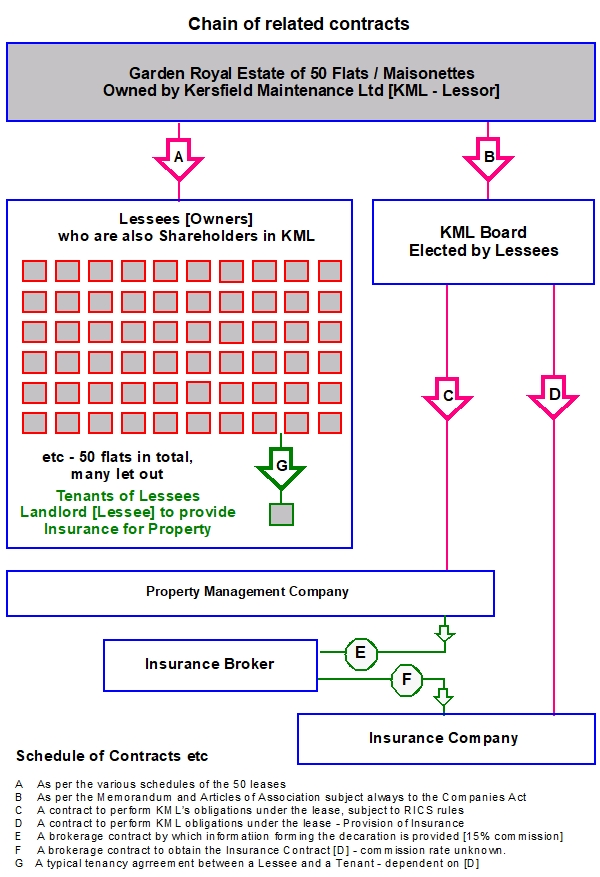
- The contractual relationships affecting lessees, and
- The way in which a Managing General Agent operates.
In August 2011, Allianz the then property insurer pulled the plug. The cause was identified as:
- A false declaration failing to identify the cladding erected in 2017.
- The blame for this was laid at the door of Ms Varszegi, the person in charge of managing Garden Royal on behalf of J C F Property Management.
- It is probable that she was acting on the instructions of the Board who had contrived to have the cladding erected.
- Ms Varszegi was censured by the IRPM's disciplinary committee then under the direction of Amanda Gourlay of Tanfield Chambers.
The cause of the current situation of the estate being uninsured is difficult to ascertain. The Managing General Agents Association, initially apparently helpful, changed. The responses received from the broker [Insurety] appear to demonstrate a close relationship with the Board, in particular the blame for Allianz' departure being put on the the Broker Clear Insurance. This is irrelevant to the current situation, but does serve to indicate a close relationship.
It should be explicitly noted that Grace Miller have attempted to distance themselves from procuring the insurance. The terms of their appointment as property manager, which have they have refused to provide, are therefore critical to their liability. Their appointment as Company Secretary places a different burden on them to look after the interests of the Shareholders, even at the expense of the Directors.
The statement: "The Insurer is fully aware of the material facts regarding the construction methods used – these details are fully contained within the Statement of Fact which has been circulated with the responsible parties." indicates where the source of the error probably lies - with the Board and Robert Mayo of Insurety.
The Financial Conduct Authority was clear in that a complaint should be raised by email with Blair Houston, which was done, and at the second attempt was auto acknowledged.
The matter is now with the Financial Services Ombudsman, who helpfully completed their complaint form over the telephone - which at 78 is amazingly helpful.
The questions appear to be:
- Is the estate insured in the light of the express statement made by Robert Mayo ?
- Will "Accelerant" be able to get the Garden Royal Estate insured in the light of the 10% flammability clause, which calculations show is exceeded by a factor of between two and four.
Property Redress Scheme - A conversation
This is simply my contemporaneous note, which I often make in reverse order - i.e. last comments at the top.
The text is copied from their "chatbot".
Fore more information visit https://www.propertyredress.co.uk/
A stupid and stubborn response
Good night.
Unfortunately Glasgow University's research has no impact on how we investigate or our procedures, for a complaint to be raised to us first it needs to be raised to the agent in writing, through their complaint procedure if they have one, from the date the complaint is raised they get 8 weeks to resolve the complaint, if they cannot resolve it within 8 weeks it can be raised to us, alternatively if they offer a non-suitable resolution as their final stance it can then be raised to ourselves at that point to investigate.
Once the above has been met you can then raise the complaint to us to investigate
And I have told you that Glasgow University's research is what we all agree with.
AFTER to have read the paper come back to me
I have explained the procedure of how to raise a complaint with us
Brown & Brown is the company that owns Property Redress through Hamilton Fraser
Having indicated your intention of being useless - not a lot.
But get wise - see what is being said about you.
And just who are Brown and Brown ???
Is there anything I could assist with?
The evidence is on the web site in plain view for all to see . . .
And you guys wonder why the leasehold community thinks you are ALL a waste of space . . .
Unfortunately we are evidence based and have a set procedure that needs to be followed so we can investigate the agents service formally, once the complaint is raised online to us
Had complaining - It would save everyone a lot of effort if you rang grace miller and read the riot act . . .
They will say "we are [unlawfully] instructed to ... [break the law]" and you will do nothing !
So what ????
Josh - expect to see your name on the web !
You will need to complete the online form to raise the issues to us if you want us to investigate the members service
Prefer the FCA route . . .
BUT if you want to make yourselves useful, which I doubt, the get he missing data sent to me.
THIS IS a RECORDED Message
https://www.portal.propertyredress.co.uk/Complain
If they have responded to the formal complaint with an unsuitable resolution the complaint can be raised to us, we have an online complaint form you will need to complete
Have done that . . .
They say that it is not them . . . they are only advising our Board.
The Story is here:
https://tdocplus.co.uk/01_ROPA/index.php/from-1st-april-2025/on-insurance
The correspondence is alongside . . . they have refused to supply all the ingredients of the insurance contract - especially the declaration / statement of fact and the terms and conditions.
Great thank you for confirming, you would first need to raise the complaint with the member, they will get 8 weeks form the date the complaint is raised to resolve the complaint, if they cannot resolve this within 8 weeks or offer a non suitable resolution and it is their final stance you can then raise this with us, ensure moving forward all communication with them is done in witing as this will help support your case.
Grace Miller - they are members of Property redress.
Please may I have the companies name as if they are not members of a redress scheme, the only thing we could is advise you to report them to Trading Standards.
Our estate is not insured what do we do ?
Property Redress Scheme - Ownership
HF Resolution Ltd. is a private limited company in England that operates several schemes, most notably the Property Redress Scheme and the Cosmetic Redress Scheme. It is a trading name for HFIS Limited and was incorporated on April 14, 2014. The company's registered office is in London, and it employs various staff members to manage its alternative dispute resolution services
Company number: 08994516
Incorporated: April 14, 2014
Registered office: 7th Floor Corn Exchange, 55 Mark Lane, London, EC3R 7NE
Nature of business: Activities of other membership organizations not elsewhere classified
Parent organization: HFIS Limited
Subsidiary: Landlord Action Ltd [https://find-and-update.company-information.service.gov.uk/company/08067511]
https://find-and-update.company-information.service.gov.uk/company/03252806
EBITDA stands for Earnings Before Interest, Taxes, Depreciation, and Amortization
Find out more here: https://www.hfis.co.uk/our-brands
One has to ask whether it is right and proper for an "Ombuds Service" to own a firm of litigation lawyers . . . Indeed is it right and proper for an "Ombuds Service" to be owned by a firm specialising in property ?
Research Documents
Note: This document is "Work in Progress"
Document Categories
These documents fall into the following categories:
- Service Charge Accounts - published using data provided by KML to a Chartered Accountant who in their words "tops and tails" them. The accounts are NOT audited in the true sense of the word, nor are they even rigorously checked - thos the reportys use words suach as "sampled".
- Minutes of the Annual General Meetings [when held]. It has become clear over the last decade that they they often:
- Include matters which were NOT discussed, and
- Failed to include matters which were brought up.
- Miscellaneous papers and documents issued by the Board from time to time, including responses to questions which were evaded at the AGM.
Document List
The following is a list of the documents which have been used - it is NOT and exclusive list, and may not be complete:
Conclusions
???
On Fiduciary Duty
Some information gleaned from using Google's AI
Definition of Fiduciary Duty
A fiduciary duty is a legal obligation to act in the best interests of another person or entity, requiring utmost loyalty, good faith, and prudence, often in relationships of trust like trustee/beneficiary, solicitor/client, or director/company, preventing self-dealing, conflicts of interest, and unauthorized profits
A fiduciary duty is a legal or ethical obligation of trust and confidence that one party (the fiduciary) owes to another (the principal or beneficiary). The core principle of this duty is that the fiduciary must act solely in the best interests of the beneficiary, even above their own interests.
Thus it's a high standard of care, meaning the fiduciary must prioritize the other party's interests above their own.
Key Principles / Core Duties
The precise duties depend on the specific relationship and jurisdiction, but generally include:
- Duty of Loyalty: Act solely for the benefit of the principal, avoiding personal gain or benefit for third parties without full disclosure and consent.
- Duty of Loyalty: The fiduciary must put the beneficiary's interests first and avoid any conflicts of interest.
- No Conflict Rule: Do not put oneself in a position where personal interests clash with duties owed to the other party.
- No Profit Rule: Do not make unauthorized profits from the position of trust.
- Duty Not to Profit: A fiduciary must not make an unauthorised profit from their position unless they have the principal's informed consent.
- Duty of Care/Skill: Act with the competence and diligence expected, often codified for specific roles (e.g., directors, trustees).
- Duty of Care/Prudence: The fiduciary must exercise reasonable skill, diligence, and caution in managing affairs, as a prudent person would with their own matters.
- Duty to Act in Good Faith: All actions must be honest and made with integrity.
- Duty of Confidentiality & Disclosure: Fiduciaries must maintain confidentiality of sensitive information and disclose all relevant information required by the principal.
Key Concepts
- Relationship of Trust: A fiduciary relationship is one where the principal is reliant on the fiduciary to exercise power or act on their behalf, creating a legitimate expectation of loyalty and good faith.
- Highest Standard of Care: Fiduciary duty imposes a strict standard of behavior, often described as a single-minded loyalty, which is generally a higher standard than the common law duty of care.
- Informed Consent: A fiduciary can potentially avoid liability for actions that might otherwise be a breach if they make a full and frank disclosure of all relevant information, and the principal provides fully informed consent.
Common Fiduciary Relationships
Typical Applications
- Trustees: To beneficiaries.
- Company Directors: To the company and its shareholders.
Examples in Practice (Directors)
- Act in the company's best financial interests.
- Use company information and property only for company purposes.
- Avoid situations where their personal gain conflicts with the company's interests
Consequences of a Breach
A breach of fiduciary duty can have significant legal and financial consequences. The fiduciary may face personal legal liability and can be sued by the principal. Potential remedies awarded by a court can include:
- Account of profits: Forcing the fiduciary to give up any profits made as a result of the breach.
- Equitable compensation/Damages: Monetary awards to compensate the principal for any losses incurred.
- Rescission: Setting aside a transaction that was conducted in breach of duty.
- Injunction: A court order to stop the fiduciary from taking a certain action.
- Removal: Removing the individual from their position (e.g., as a trustee or director).
The Institute of Directors [IOD]
The IOD has a number of relevant "fact sheets" on their web site at https://www.iod.com/resources which include:
- Directors’ duties and responsibilities
- The role of the company secretary
These further explain the duties of Directors and Company Secretaries.
For more information on various persons click here: 22nd January 2026 - link removed at request of Fast Hosting Direct.